AI reads minds, makes pictures

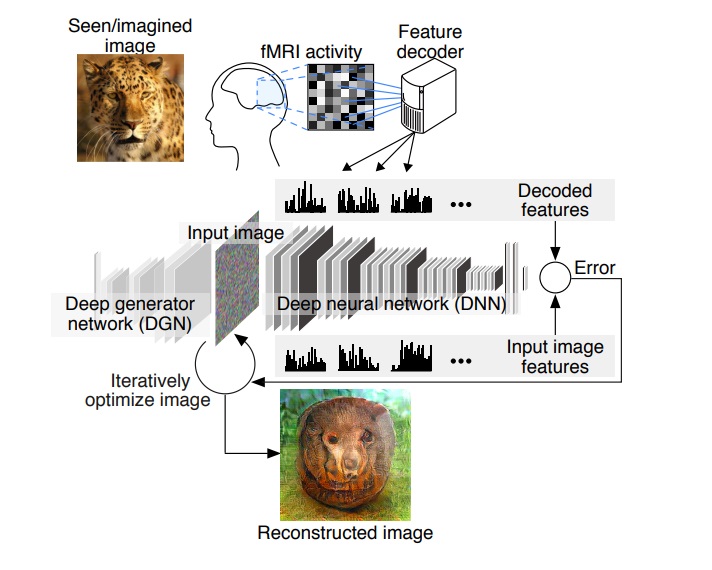
As reported by Tristan Greene on The Next Web, scientists at Kyoto University in Japan have created a deep neural network that can decode brainwaves.

That’s right, AI that can read your mind.

Tristan summarizes:

“When these machines are learning to “read our minds” they’re doing it the exact same way human psychics do: by guessing. If you think of the letter “A” the computer doesn’t actually know what you’re thinking, it just knows what the brainwaves look like when you’re thinking it…. AI is able to do a lot of guessing though — so far the field’s greatest trick has been to give AI the ability to ask and answer its own questions at mind-boggling speed. The machine takes all the information it has — brainwaves in this case — and turns it into an image. It does this over and over until (without seeing the same image as the human, obviously) it can somewhat recreate that image.”

Or, as Guohua Shen, Tomoyasu Horikawa, Kei Majima and Yukiyasu Kamitani illustrate:

To my eye, some of the results look awfully reminiscent of William Turner‘s oil paintings, particularly Snow Storm.

See the full paper.

My take: Let’s be honest. This technology, as amazing as it is, is not yet ‘magical.’ (Arthur C. Clarke‘s third law is, “Any sufficiently advanced technology is indistinguishable from magic.”) However, if we think about it a bit and mull over the possibilities, this might one day allow you to transcribe your thoughts, paint pictures with your mind or even become telepathic.

Google uses neural net to synthesize female voice

Research at Google is making huge advances in text-to-speech (TTS) technology. Check this out:

From their Twitter post:

“Building on TTS models like ‘Tacotron’ and deep generative models of raw audio like ‘Wavenet’, we introduce ‘Tacotron 2’ a neural network architecture for speech synthesis directly from text.”

How do they do it? From their blog post:

“In a nutshell it works like this: We use a sequence-to-sequence model optimized for TTS to map a sequence of letters to a sequence of features that encode the audio. These features, an 80-dimensional audio spectrogram with frames computed every 12.5 milliseconds, capture not only pronunciation of words, but also various subtleties of human speech, including volume, speed and intonation. Finally these features are converted to a 24 kHz waveform using a WaveNet-like architecture.”

The results are amazing.

Want more? Here’s the full research paper.

The limitations? Some complex words, sentiment and generation in real time. “Each of these is an interesting research problem on its own,” they conclude.

Listen to more samples.

My take: I’ve used TTS functionality to generate speech for songs and for voice-over. I love it! As the quality improves to the point where it becomes indistinguishable from human voice, I will admit that I’m not quite sure what that will mean in a future where we won’t be sure if the voice we’re hearing is human or robot.

Netflix in 2018

As we move into 2018, a quick recap on the strength of Netflix’s streaming domination:

  • Netflix subscribers around the world watched more than one billion hours per week
  • The average subscriber watched approximately 60 movies in 2017

As reported widely, Neflix intends to spend upwards of $8 billion on new content in 2018. The New York Times lists some of the new films coming this spring:

  • “The Polka King” starring Jack Black
  • “Step Sisters”
  • “A Futile and Stupid Gesture” starring Will Forte
  • “When We First Met”
  • A revival of the “Benji” franchise
  • “Roxanne Roxanne”
  • “Come Sunday” starring Chiwetel Ejiofor

Even more new TV series are coming this year.

Nevertheless, there’s backlash…

Ben Kuchera writing on Polygon complains that:

“Netflix believes that its business begins and ends in your living room, which means any movie it buys will lose its shot at a theatrical release.”

He goes on to quote Noah Baumbach talking about his Netflix experience with “The Meyerowitz Stories (New and Selected)“:

“To be clear, I didn’t make the movie with Netflix. I made the movie independently, as I’ve made all my movies. I wasn’t even thinking of an alternative — I was thinking this would be shown in theaters, as all my movies are. Netflix acquired it from my producer in post and they have their way that’s important to them…. But I think it’s a singular experience, seeing a movie in the theater. I think audiences should be given the opportunity to see things for the first time that way.”

Netflix is even using their model for blockbusters. The $90 million Bright got savaged by the critics but that doesn’t seem to have scared away viewers.

My take: Although not quoted above, Baumbach also went on to say, “We all end up there anyway — all movies are going to end up on these servers, and that’s great.” The reality is that theatrical releases are very expensive. And the cost per viewer, versus streaming, is astronomical. My advice: add a clause to your contract that lets you four-wall a cinema and hold exclusive screenings for your best supporters. An audience of three hundred or so viewers can’t bother Netflix too much, can it?

The Attention Economy and the blockchain

Five years ago, I was thinking about a semitransparent way for creators to get paid for their work on the Internet.

Now, someone’s come along and made my dream a reality. And thrown in the blockchain and a cryptocurrency to boot.

Synero, based in Israel, is…

“…developing tools which allow content creators to easily monetize original works without having to turn their channels into advertisment real estate, while granting their followers the opportunity to be rewarded for getting the word out. Simply put, the attention you generate online is worth money. The better the content you create, the more followers you have, the more attention flows around you. Synereo’s applications and monetary models enable you to tap into this resource and reap the fair share of what you create online. Not a content creator? In a world overloaded with information, good taste is as valuable as creative talent. Help curate quality content, and earn your share by promoting creators you appreciate.”

That’s interesting enough. That they intend to use the blockchain and a cryptocurrency to accomplish their goal makes this super-interesting. They have a phased roadmap to accomplish it all.

To be honest, there’s a whiff of a ponzi scheme about the way compensation is distributed.

But wait, there’s more! You won’t get paid in cash, but in a new cryptocurrency called AMP. Super legit, right?

Here are a three more charts on the AMP altcoin.

If you want to do this today:

  1. Get the Chrome Extension
  2. Sign up as a WildSpark Creator

Before you pooh pooh this, see what CMF Trends has to say about them.

My take: I think the frictionless compensation the blockchain could deliver to creators (and potentially influencers) would go far in acknowledging their contributions to the sharing economy. Will it be WildSpark? Not sure. Will the old economy kick and scream about any and all disruption? For sure!

Become a Film Patron today!

My buddy Bryan Skinner needs your help.

He’s making his first feature mockumentary in February 2018 and to do so he’s raising money now.

“Open for Submissions” is about the shenanigans at a film festival, so it’s only natural that Bryan would hold a “Best of the Worst” competition to get the “bad” films he needs. Of course, I’m up for that challenge.

See the trailer for my entry, “The Dolphins”:

Here’s Bryan’s pitch video for “Open for Submissions”:

And here’s Bryan’s project video for “Open for Submissions”:

My take: I have supreme confidence in Bryan and his team being able to complete this project. If you are a filmmaker or you know creative people making art, you should back their vision and become a film patron. It’s easy and you will feel great!

Copyright infringement case contends Hollywood CGI characters are illicit derivatives

Eriq Gardner, writing in The Hollywood Reporter, reports on the curious case of the alleged copyright infringement of stolen software output of CGI characters by some of the biggest studios.

The case was brought forward by Steve Perlman and his Rearden Companies. They claim their proprietary facial movement capture software, MOVA, was stolen by two Chinese companies and then licensed to Disney, Fox and Paramount.

See their opposition to the motion to dismiss.

Rearden previously received an injunction to stop Hollywood companies from using MOVA while its ownership was being contested.

My take: This could be huge, if the judge agrees with the case. But it would boil down to money — and how much the studios would have to pay to get their characters back. Perlman must be pretty upset about the Chinese companies ripping off his software though. After all, this is the creator of WebTV, one of the first set-top boxes for TV connectivity to the Internet. He’s a serial disruptor who’s still working on improving connectivity. See this pCell interview.

Netflix to spend $8 billion on content in 2018

Two stories about Netflix and content this week:

According to Mike Fleming Jr on Deadline Hollywood Netflix is bankrolling the Shaft reboot in exchange for international rights.

“Netflix will pay more than half the film’s high $30 million budget, in exchange for international rights and the ability to put the film on its streaming outside the U.S. two weeks after New Line releases theatrically in the United States. The film will begin production in December. New Line and Netflix were not commenting, but sources said the film will follow a traditional domestic roll out from theatrical to SVOD and DVD through the Warner Bros machine.”

Brandon Katz reports on the Observer that Netflix is planning on spending $8 billion next year.

“Netflix dropped a cool $6 billion on content in 2017 alone and is planning to shell out a whopping $8 billion next year, $1 billion more than previously planned. While the company’s long-term forecast is a bit cloudy with a growing $20 billion debt looming over its head, the short-term prognosis is bright and sunny. The streaming giant added 5.3 million new subscribers in the last quarter, crushing its own internal goal and raising its worldwide total north of 104 million.”

See the investor relations shareholder letter for details.

My take: these stories are interesting because Netflix now has more paid international subscribers than paid US subscribers and demonstrates its commitment to producing more and more original content. There’s no denying internet television is the future.

OC4: Zuck promotes first standalone VR headset

At the recent Oculus Connect 4 Keynote presentation in San Jose, Mark Zuckerberg promised a new VR headset that straddles the space between Mobile VR that uses your smartphone and Computer VR that uses your high-end computer: the standalone Oculus Go.

Shipping in early 2018, Oculus Go will cost $199 USD and features:

  • Crystal-clear optics
  • 2560 x 1440 resolution
  • Integrated spatial audio
  • Designed with breathable fabrics and adjustable straps

Lance Ulanoff writing in Mashable has an interesting take on the price:

“Why is $199 such a good price? It’s not super cheap, but believe it or not, it appears to trigger a response in consumers. Ask them to pay $300 or more for cutting-edge technology, especially something as unproven as virtual reality that still needs more expensive hardware to work, and they balk (Oculus sold just 355,000 Oculus units in 2016). But set a sub-$200 price, even just a dollar below that threshold, and consumers are ready to take the leap. Apple wasn’t even the first to discover this magical price point. Back in 2002, the very first iRobot Roomba robotic vacuums were priced at $199.95. Even though they’ve since gotten a lot more expensive, that initial magic price point helped launch a robot vacuum industry.”

My take: I think this will be a game changer. It’s perfect for everyone who wants to get into VR but doesn’t want to buy a Samsung phone or a PC computer.

Computational Video Editing may replace Assistant Editors

Eric Escobar writes on Film Independent about his trip to Siggraph 2017 and the one technology that blew his mind: Computational Video Editing.

Three researchers from Stanford University and one from Adobe demonstrated a system that:

“automatically selects the most appropriate clip from one of the input takes, for each line of dialogue, based on a user-specified set of film-editing idioms. Our system starts by segmenting the input script into lines of dialogue and then splitting each input take into a sequence of clips time-aligned with each line. Next it labels the script and the clips with high-level structural information (e.g., emotional sentiment of dialogue, camera framing of clip, etc.). After this pre-process, our interface offers a set of basic idioms that users can combine in a variety of ways to build custom editing styles. Our system encodes each basic idiom as a Hidden Markov Model that relates editing decisions to the labels extracted in the pre-process. For short scenes (< 2 minutes, 8-16 takes, 6-27 lines of dialogue) applying the user-specified combination of idioms to the pre-processed inputs generates an edited sequence in 2-3 seconds.”

That’s right. Three seconds. For a 90 second scene. Versus 90 minutes for a human. If my math is correct, that makes this system 180,000% faster!

The idioms, from the research notes:

  • Avoid jump cuts
  • Change zoom gradually
  • Emphasize character
  • Intensify emotion
  • Mirror position
  • Peaks and valleys
  • Performance fast/slow
  • Performance loud/quiet
  • Short lines
  • Speaker visible
  • Start wide
  • Zoom consistent
  • Zoom in/out

Editors combine a number of these idioms and weight them to generate different assemblies of the rushes, automatically.

Of course, editors will then proceed to polish these rough cuts, tweaking the edits and finessing the sound.

My take: This promises to take out all the tedium in editing and let editors focus on truly being creative. Eric envisions a client-side version of this in which every viewer’s version of a film is custom-generated for them, based on their favourite editing style. That may be going a little too far but what I find fascinating about this system is that it starts with the script, once again highlighting how crucial it is.

Netflix just invited itself to your child’s next birthday party!

Streaming juggernaut Netflix wants to sing your child Happy Birthday.

From their September 14, 2017, media release:

“With this new hack, parents can simply press play and kids’ favorite characters will sing them a special birthday greeting – made just for them (or so they’ll think).”

Some of the Birthdays On-Demand animated characters:

  • All Hail King Julien
  • Barbie
  • Beat Bugs
  • Dinotrux
  • Las Leyendas
  • LEGO Friends
  • LEGO Ninjago
  • Luna Petunia
  • My Little Pony
  • Pokemon
  • Project Mc2
  • Skylanders Academy
  • Trollhunters
  • Word Party

Just search for ‘birthday songs’ to find all.

(Netflix also did something similar for New Year’s Eve last year.)

My take: this is brilliant! Netflix has combined a targeted audience (children) with an annual event (birthdays) and created media that has huge long-tail appeal. This could only be better with some customization. And more characters. I’m thinking on the adult side, where accounts (in our home) are named. How difficult would it be to have Walter White or Frank Underwood spell out (or even say) my name? (Birthday is coming up soon! Hint, hint.)