What is the difference between USB-C and Thunderbolt?

Now that Apple has brought a USB-C port to the iPhone 15, it’s time to review how USB-C differs from Thunderbolt.

Similarities:

  • They look alike.
  • They are compatible with each other.

How to identify similar cables:

  • A Thunderbolt connector will have a lightning bolt symbol on it.
  • No lightning bolt? Then it’s a USB-C connector.

Keep in mind:

  • Use Thunderbolt cables between Thunderbolt devices to get the fastest transfer speeds.
  • Thunderbolt 4 runs at 40Gbps, up to four times faster than USB-C.
  • USB-C cables marked SS (for Super Speed) are faster than USB 2.0 cables.

(See Cult of Mac for more.)

My take: turns out, a cable is not just a cable! I wonder if there’s a plug in device to tell you if your cable is legit and what speeds it supports. But whatever you do, don’t check out this video if you’re paranoid.

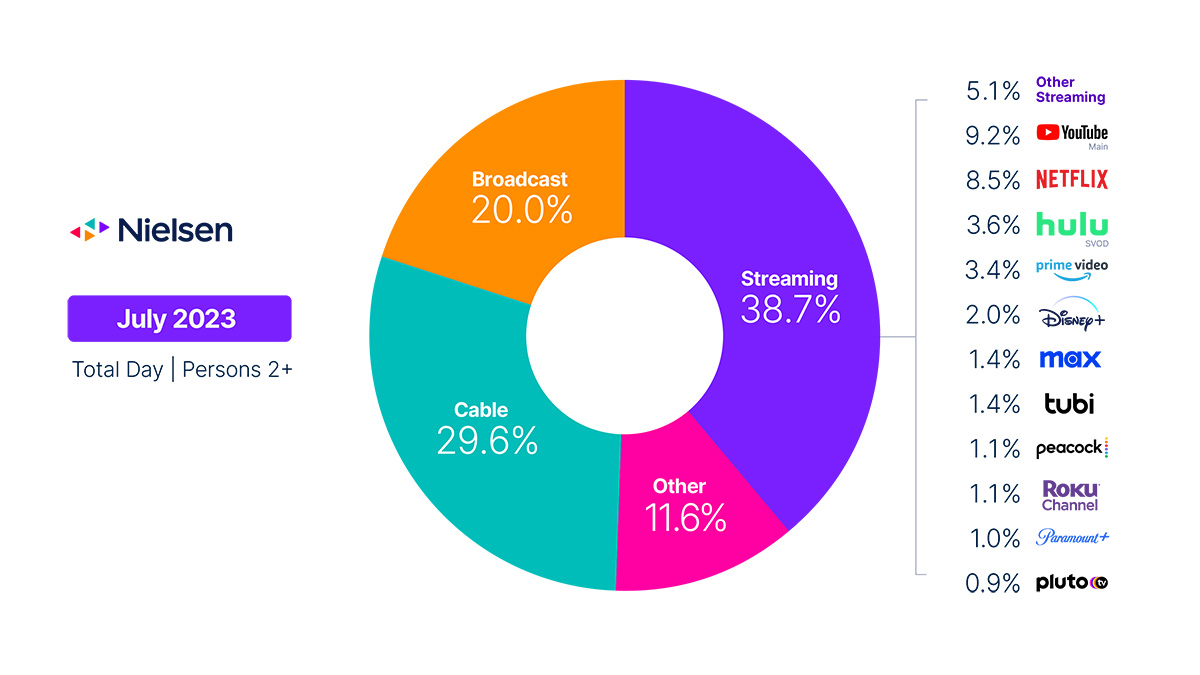
Broadcast Surpassed by Streaming in July 2023

Nielsen relays that Streaming grabs a record 38.7% of total TV usage in July 2023.

Streaming: “Acquired content was the stand-out for the month. Suits… set new viewing records for an acquired title, amassing almost 18 billion minutes. In aggregate, the heavy viewing levels pushed streaming’s share of TV to 38.7%, a new record, with Amazon Prime Video, Netflix and YouTube all hitting all-time highs.”

Broadcast: “Drama remained the most watched category, capturing 25.7% of viewing. Overall, total broadcast viewing was down 3.6% to finish the month at 20% of TV, representing a new low.”

Cable: “Cable viewing slipped as well, losing a full share point to capture 29.6% of TV in July. Feature film was the only genre to see a rise in viewership (0.5%).”

Other includes video on demand (VOD), audio streaming, video gaming, as well as Blu-ray/DVD playback.

My take: According to Nielsen, Broadcast and Cable TV viewing totalled 49.6% or just less than half. Of course, when the NFL and the NHL roar back in the Fall, these numbers will increase. But still….

Sony tests cameraless virtual production

Jourdan Aldredge notes on No Film School of Sony Testing Real-Time Cameraless Production for New Ghostbuster Movie.

He writes:

“Sony Pictures Technologies has unveiled its latest developments in real-time game engine technology with this new proof-of-concept project…. Its “cameraless” virtual production style… intends to allow developers to use this real-time game engine to produce a scene live on a motion capture set.”

Jason Reitman, who wrote and directed the two-minute scene in one day, says:

“I love filmmaking in real places with real actors. So for me, this is not a substitute. If I were to make Juno again today, I would make Juno exactly the same way. What I see here, what thrills me, is if I wanted to make a movie like Juno that took place in ancient Rome, I wouldn’t be able to do that because it would cost $200 million to make Juno. And that’s not cost effective. There’s no studio who would sign up for that. You can make Ghostbusters for a lot of money, but you can’t make an independent film in an unexpected location. You can’t make an independent film underwater, on the moon or, you know, a thousand years ago or into the future, and what thrills me about it is the possibility of independent filmmakers who want to tell their kind of stories, but in environments that they don’t have access to with characters that they don’t have access to, and the possibility of getting a whole new wave of stories that you could read in a book, but you would never actually get in a film.”

My take: While I agree with Jason Reitman that this technology is promising, I think their finished scene is underwhelming. It’s just not believable. For instance, the folks on the sidewalks are obviously from a video game. The traffic is not real world either. And the actor is not human; he’s a marshmallow! However, this might be where superhero comic book movies are going: totally computer-generated, with the faces of the stars composited onto the quasi-lifelike animation. (My nightmare situation: those faces and voices are AI generated from scans and recordings!)

AI delivers on “Fix it in post!”

Michael Wynne, an audio mastering engineer, just claimed on his In The Mix channel: I Found The Best FREE AI Noise Reduction Plugin in 2023.

The tool is a free AI de-noising and re-reverb plugin called GOYO by South Korea’s Supertone AI.

Michael begins:

“I’ve used many of the sort of more premium and expensive dialogue, restoration and denoising softwares, and those are very good, but I haven’t come across a free tool that even comes close to what is offered by those. So I was really curious, downloaded it, tried it in my DAW and video editor, and was just completely shocked by the results.”

There are three dials: Ambience, Voice and Voice Reverb. You can solo, mute, decrease or increase each band. Simple and powerful!

His expert tip:

“My favourite way to use these sorts of tools is to dial them in and then print the results. So I would control this to the amount I’d like. I would export that as a new WAV file, take a listen and then work with that so that I know that the next time I open up the session, it’s going to be exactly the same.”

The How to Use page from Supertone is quite sparse so Michael’s examples are great.

My take: the perennial joke on set has always been, “We’ll fix it in post.” Well, now that’s possible for sound! I’ve used this on a short and can attest to its ease of use and incredible results. I concur with Michael that it’s best to print out each voice track as a WAV file and re-synchronize it to the timeline because I found that either the effect did not persist between sessions or the values had reset to zero or the effect was present but the numbers displayed as zero. My other tip is to only use the graphical user interface (and do not use the Inspector) as this seemed to work best. After all, this is a free beta!

The ticktokification of media and how to stop doomscrolling

Enrico Tartarotti of @enricotartarotti on Youtube asks the question: Short Form Content Is BROKEN. Can We Fix It?

Enrico believes, in his own words:

TikTok, YouTube Shorts and Instagram Reels have taken over the internet and completely changed how we view content by spreading short form content and videos everywhere. But… they are already failing. Meanwhile, long form content is having a renaissance. There is a way to save our brains from frying off retention hacks and that is… joining forces.”

He presents his case in five chapters.

  • Part 1: Why everything became a copy of TikTok
  • Part 2: Attention spans and retention black holes
  • Part 3: The Problem — falling apart
  • Part 4: The other side
  • Part 5: The Solution — the missing link

His solution? Enrico proposes changes that will harness society’s doomscrolling dopamine addiction.

  1. Link long and short content in a meaningful way, so that shorts lead to more in-depth media
  2. Change what the algorithm optimizes for, to packages of both short and corresponding longer media
  3. Allow creators to build real businesses, so they can live meaningful lives and still contribute to society.

Well worth 15 minutes!

My take: Fascinating! I will admit to wasting hours of time scrolling through short form content and I detest the “endless scroll” design of modern media apps. I like that Enrico links the rise in short form content with the rise in the sheer number of videos, suggesting that this is merely a solution to discoverability.

How to piss off film festivals in 16 easy steps

Elliot Grove lists on Raindance the 16 Things Film Festivals Hate About Filmmakers.

Here are the points but please visit the site for the full elaboration:

  1. Filmmakers who don’t read the festival rules and regulations
  2. Filmmakers who don’t complete submission details
  3. Filmmakers who send wrong or incorrect email and telephone numbers
  4. Filmmakers who are incommunicado
  5. Filmmakers who are too communicative
  6. Filmmakers who are having fights with their team
  7. Filmmakers who haven’t cleared music rights
  8. Filmmakers who send faulty preview discs
  9. Filmmakers who want us to watch their films on DVD
  10. Filmmakers who send bad production stills
  11. Filmmakers with no social network
  12. Filmmakers without a press kit
  13. Filmmakers who are rude
  14. Filmmakers who don’t understand the role of a festival
  15. Filmmakers who fall for cons
  16. Filmmakers who ignore relationships

In other words, if you want to be loved by film festivals, do the exact opposite of this list.

My take: FilmFreeway lists over 13,000 film festivals. The biggest piece of advice that I think is missing from Elliot’s list above is: choose wisely. In other words, understand the goals for your film, set a budget and then narrow down your list of festivals to the ones that have shown films like yours in the past. Be honest with yourself about the film’s quality and uniqueness. After all, it will be competing against potentially thousands of other submissions: “For TIFF, we get between 4,000 to 4,500 films every year. Sundance gets 10,000 to 11,000 every year.”

Barbenheimer continues to wow in weekend 2!

July 21, 2023, saw the release of both Greta Gerwig‘s Barbie and Christopher Nolan‘s Oppenheimer, and rather than cannibalize each other’s audience, this synergistic counter-programming resulted in the fourth biggest combined weekend box office of all time.

But the numbers don’t lie. Barbie is more popular than Oppenheimer, earning twice as much. Their combined total is well over $1B to date.

My take: It appears plastic out-punches plutonium.

Sound of Freedom motivates its audience to support justice by watching

William Hughes asks on The A.V Club: How the hell did Sound Of Freedom make $100 million?

He begins:

“It’s not every day that a $15 million movie, released by an independent producer, and paid for at least in part through crowdfunding, can climb to the top of the box office charts. And yet, that’s exactly the fate that’s greeted Angel Studios’ Sound Of Freedom, which has just passed the $100 million mark after just three weeks in theaters, making it the most successful independent film of 2023 by a country mile.”

Sound of Freedom stars Jim Caviezel and was produced by Angel Studios.

The Numbers charts Sound of Freedom in second place at the US box office for the week starting July 14, 2023.

Brian Welk on IndieWire explains the marketing and financing of the film.

My take: you would think a movie about child trafficking would be a tough sell. Faith-based Angel Studios created a community of motivated producers who greenlit this project. It then developed a Pay It Forward scheme allowing people to buy free tickets for others. Both raised money and created invested promoters. The power of community!

Hollywood Writers and Actors on strike together for first time in 63 years

Katie Kilkenny and Winston Cho report in The Hollywood Reporter that Actors and Writers Make History With Bid to Reshape Industry in Hollywood’s High-Stakes Strike.

They lead with:

“On July 13, SAG-AFTRA, led by president Fran Drescher, called the union’s first strike against film and television companies in 43 years. Combined with Hollywood writers ongoing strike, the work stoppage — applying to 160,000 members, from actors to singers to dancers — marks the first simultaneous strike by the two unions since 1960, in a sign of an industry in tumult.”

In a redefined industry that now embraces streaming, the issues are pay, residuals, benefits and — AI.

“During the 2023 round of negotiations, the union has been seeking to codify consent and compensation terms for performers when their work is ingested into AI technology, and create guardrails around potential uses. The AMPTP said it offered a ‘groundbreaking AI proposal which protects performers’ digital likenesses, including a requirement for performer’s consent for the creation and use of digital replicas or for digital alterations of a performance.’ Duncan Crabtree-Ireland, SAG-AFTRA’s chief negotiator and national executive director, on July 13 denounced the proposal for only paying background performers for one day of work in exchange for the rights to their digital likeness ‘for the rest of eternity with no compensation.’ He added, ‘If you think that’s a groundbreaking proposal, I suggest you think again.'”

USC history professor Steve Ross, who studies entertainment labour, says this time there’s an “existential threat to writers and potentially to actors. This is no longer just about improving your wages and your benefits. This is about keeping your job in the future.

My take: Workers of the world, unite!

A Better Green Screen

Devin Coldewey reports on TechCrunch that Netflix’s AI-assisted green screen bathes actors in eye-searing magenta.

Netflix researchers have described an experimental way to create more accurate green screen mattes. They propose lighting subjects with magenta light in front of a green background. Devin says:

“The technique is clever in that by making the foreground only red/blue and the background only green, it simplifies the process of separating the two. A regular camera that would normally capture those colors instead captures red, blue and alpha. This makes the resulting mattes extremely accurate, lacking the artifacts that come from having to separate a full-spectrum input from a limited-spectrum key background.”

Once the mattes are created, green information needs to be added back to the subjects. The solution? AI. It learns how to do this task more accurately than a simple green filter:

Read the full paper here.

My take: Not quite ready for prime time, especially if actors need to perform under magenta lights.