When is a Film a Movie?

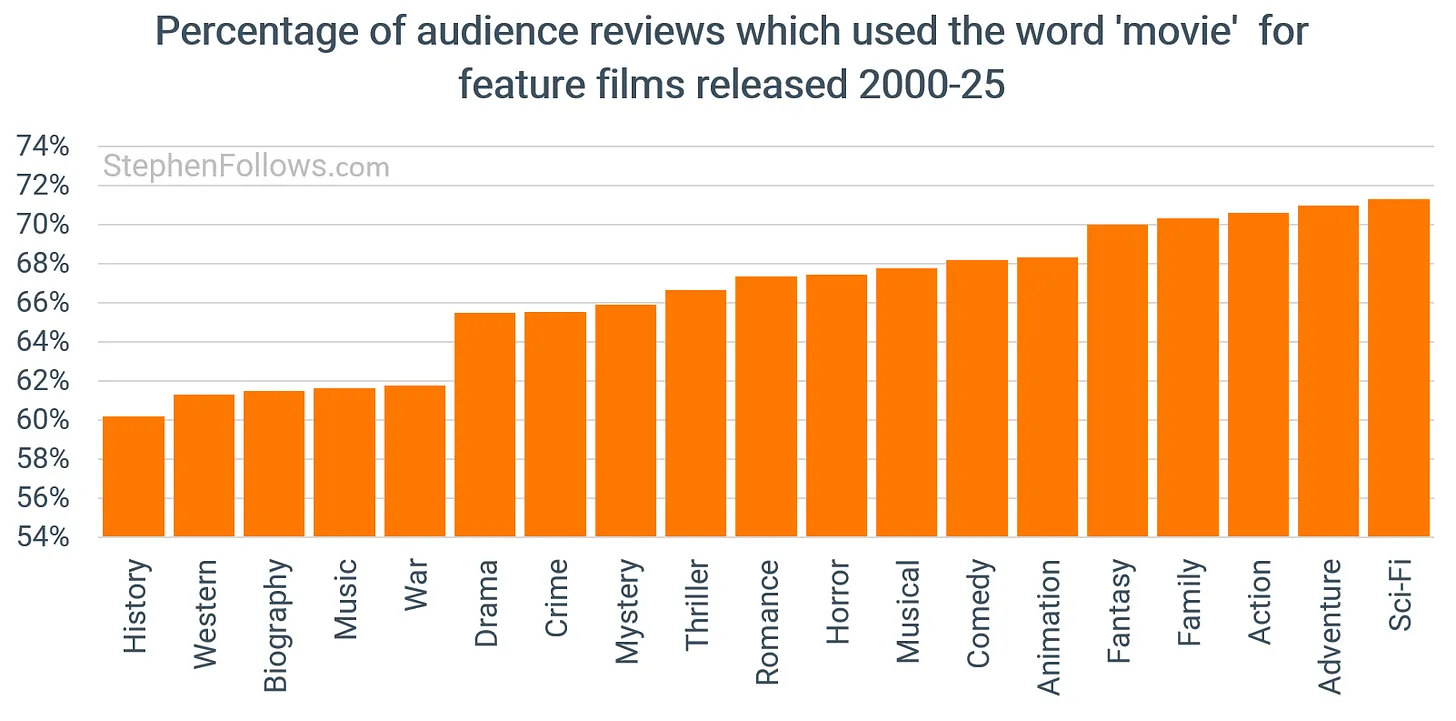
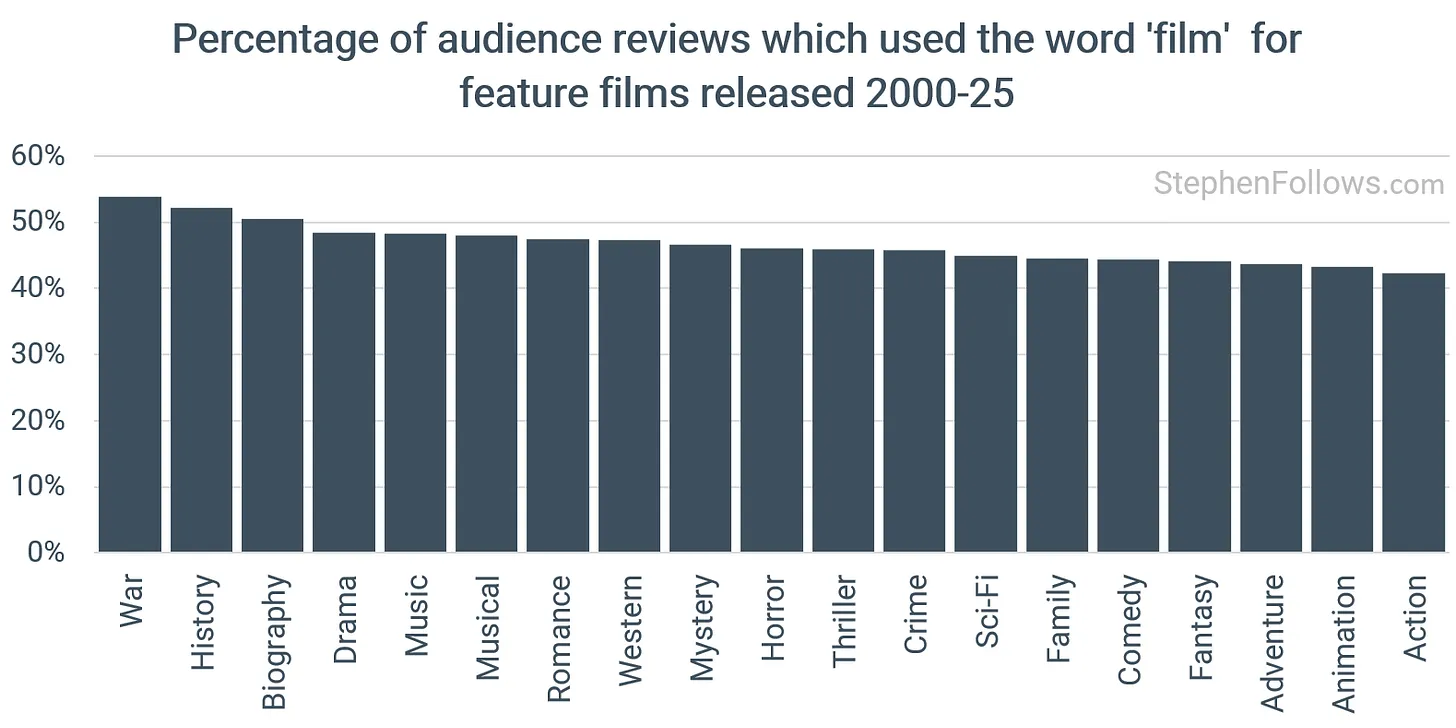
Stephen Follows asks the question, “Which types of features films are called ‘films’, and which are called ‘movies’?

His analysis reveals that audiences tend to call all films movies, with Action, Adventure and Sci-Fi genres the most likely to be “movies.”

Whereas, audiences only tend to call War, History and Biography genres “films,” with all others more likely to be “movies.”

His conclusion:

“We could say that the more fun a genre appears to be, the greater chance it has to be a movie.”

My take: no real surprise here; audiences want to be entertained. A good story, well told. Another consideration is that almost no-one actually films on film anymore.

Rio and friends step up to save Vancouver’s Park Theatre

Part of Vancouver’s film history has been saved by Corinne Lea of the Rio Theatre and a group of private investors, reports The Hollywood Reporter.


View this post on Instagram


A post shared by Corinne Lea (@corinne_riotheatre)

From her statement:

“The Rio Theatre is very excited by the opportunity to revive Vancouver’s historic, art-deco Park Theatre in the beloved Cambie Village neighbourhood. We are grateful for the support of this impressive group of film industry professionals, and could not do this without them! After almost two decades of rocking the Rio, we look forward to this expansion, and bringing the same fun, energy and passion to a new location.”

Among the investors are:

  1. Chris Ferguson
  2. Osgood Perkins
  3. Mike Flanagan
  4. Sean Baker
  5. Samantha Quan
  6. Zach Lipovsky
  7. Finn Wolfhard
  8. Graham Fortin
  9. Eugenio Battaglia
  10. Andy Levine
  11. Jill Orsten
  12. Christina Bulbrook

My take: I applaud this effort because local control of movie screens is critical for a truly independent national cinema.

“Canadian” content definition for TV and streaming updated

On November 18, 2025, the CRTC updated the definition of Canadian content for television and online streaming services, as one step in modernizing the Broadcast Act.

Some of the key changes:

  • Uses a system that awards points for key creative roles filled by Canadians, and requires production and post-production spending in Canada.
  • Recognizes a broader range of creative roles that contribute to Canadian productions, including positions such as showrunners, heads of departments responsible for costume design, make-up artists and hair artists, and visual effects directors and special effects directors, alongside existing roles like directors, scriptwriters and lead voice performers.
  • Introduces bonus points for specific types of content, such as programs based on Canadian books.
  • Clarifies that key creative positions used to qualify as Canadian content (such as the director and screenwriter) should be held by humans, not artificial intelligence.
  • Streamlines reporting requirements for certified productions, as part of the CRTC’s ongoing efforts to reduce regulatory burden on the industry.
  • Requires collaboration between foreign streaming services and Canadian companies, ensuring that at least 20 percent of ownership rests with a Canadian partner and that a higher proportion of key creative positions are held by Canadians.

See Appendix 1 to Broadcasting Regulatory Policy CRTC 2025-299 for all the new details. PDF here.

My take: my guess is it won’t be long before CAVCO follows suit and updates their point system. One interesting note is that bonus points will be granted for Canadian characters, locations, pre-recorded music and prior written works.

How to use AI in your workflow as of November 2025

Seattle’s Yutao Han, aka Tao Prompts, has just released a great summary of the main ways to use AI tools to generate video clips.

They are:

  1. Text to Video (Google Veo 3.1 can even voice dialogue.)
  2. Image to Video (Probably the best way to ensure consistent characters.)
  3. Video to Video (More work, but worth it!)
  4. Lip Sync (The weakest link IMHO.)
  5. Ingredients to Video (This hints at the future.)
  6. Chat Edit (Sort of combines Video to Video and Text Prompting.)

Tao’s insights are very educational!

My take: really nice to have this summary of the various approaches. Note that you most definitely will use some combination of each; don’t just fixate on one tool.

The numbers behind Telefilm’s Talent to Watch 2025-26 projects

Telefilm Canada has selected 17 Talent to Watch projects to share $3.45 million from 155 submissions.

It’s quite revealing to look at the numbers in detail.

Let’s start with Type.

Narrative 9
Documentary 8

The Narrative features break down thusly:

Drama 6
Romantic Comedy 1
Sci-fi, Fantasy and Fairytale 1
Suspense 1

Province?

Quebec 7
Ontario 6
British Columbia 2
Saskatchewan 1
Yukon 1

Let’s look at Language next.

English 6
French and English 2
English and Cree 1
English and Filipino 1
English and Irish 1
English and Kannada 1
English, French and Korean 1
French 1
French and Spanish 1
French, English and Spanish 1
Japanese 1

And let’s finish up with Stream.

Filmmaker Apply-Direct 11
Industry Partner 4
Festival 1
Indigenous 1

In addition, if Gender is assumed from names:

Female approx. 20
Male approx. 18

Some observations:

  • The number of submissions is about the same as last year.
  • Non-fiction continues to be almost as successful as Fiction.
  • Drama is the most popular narrative genre.
  • Almost all of the successful projects are from Quebec and Ontario.
  • Almost half of the successful projects include other languages in addition to English and/or French — and one is in Japanese exclusively.
  • The vast majority of successful projects continue to be Filmmaker Apply-Direct.
  • Less than a quarter of the successful projects are from Industry Partners.
  • For the first time, two projects are helmed by one individual filling the director, screenwriter and producer roles, rather than a team of two or more.
  • For the second year in a row, no projects are selected from Atlantic Canada.

Hey, Atlantic Canada, what gives?

My take: this is the fourth year that filmmakers could apply directly and Telefilm has rewarded them well! Therefore, if you can apply direct, bypass your local industry partner, for odds of approximately one in nine.

Verticals, defined

Thomas Blakeley, writing on InkTip, explains Writing for Verticals: How to Break Into the New Format Producers Want.

He defines these micro-dramas thusly:

Format: 9:16 screen (like TikTok or Instagram Reels).
Episodes: 2–3 minutes each, built on intrigue and cliffhangers.
Season: Anywhere from 20 to 100+ episodes, depending on length.
Style: Hook-driven, character-focused, and designed to keep you watching one bite-size piece after another.”

He then goes into why producers want verticals, how to write a vertical and the genres producers want right now.

He concludes with this checklist:

  1. “Is your total story length 30, 45, 60, or 90 minutes broken into 2–3 minute episodes?
  2. Does each episode end on a cliffhanger or emotional punch?
  3. Can each mini-arc satisfy the viewer while feeding the bigger story?
  4. Are you keeping it tight (faces, hands, one or two characters at a time)?
  5. Is your premise simple enough to repeat across 20+ short episodes?”

My take: I believe that movies and TV should be horizontal, not vertical.

AI Avatar Rankings as of mid-2025

Dan Taylor-Watt asks Which avatar generator can create the most convincing Dan Taylor-Watt?

AI Avatar Head-to-Head by Dan Taylor-Watt

Which avatar generator can create the most convincing Dan Taylor-Watt?

Read on Substack

He tests seven AI platforms on four key criteria: visual likeness, audio likeness, movement and lip syncing.

The contenders are:

  1. HeyGen
  2. Synthesia
  3. AI Studios
  4. Mirage Studio
  5. Argil
  6. D-ID
  7. Colossyan

His top three conclusions are:

“1. Generating convincing avatar clones of real people is difficult and the human eye and ear are unforgiving of anything that’s slightly off.

2. HeyGen is still #1, although its voice likenesses remain imperfect and not a huge step on from 2 years ago.

3. Generating convincing voice likenesses appears to be more challenging than video likenesses, with ElevenLabs’ lead in this domain very apparent.”

He concludes with a great chart the summarizes cost, aspect ratio, consent and rating among other factors.

My take: great summary! I wonder how long the conclusion will remain true, with Sora 2’s Cameo feature coming soon.

Kira, perhaps the best AI-generated film to date

Hashem Al-Ghaili has made a short ostensibly about human cloning that in my opinion is one of the best AI-generated films to date.

It dives into existential questions about originality, self, isolation, and what makes a person unique.

Dan Taylor-Watt, in his post AI-generated videos that make you feel something, says:

“This 15-minute film – a cautionary tale about human cloning – was created by Hashem Al-Ghaili, a Berlin-based producer, filmmaker and science communicator. It reportedly took him 600 prompts, 12 days and $500 to produce. I find it remarkable that one person can produce such a visually rich and engaging film in less than a fortnight, although 600 prompts hints at the level of effort and creative direction required. Although some of the more obviously AI-generated shots distract and the protagonist’s likeness wobbles off at times, the storytelling and tight editing kept me engaged throughout. The Suno-generated soundtrack is also a real toe-tapper.”

More feedback here.

Kira Vale’s music from Suno is on Spotify.

My take: Kira is a high bar to match. Beyond the AI-generated video, the script, audio, music and editing are all top notch.

Hollywood vs. Tilly Norwood

Lily Ford of The Hollywood Reporter reports that the Creator of AI Actress Tilly Norwood Responds to Backlash: “She Is Not a Replacement for a Human Being”.

A new AI-generated actress named Tilly Norwood has caused a stir in Hollywood, with her creator, Eline Van der Velden of the company Particle6, claiming talent agencies are interested in signing her.

The news has sparked a fiery backlash from human actors, who see the creation as a threat to their livelihoods and the integrity of their craft.

In a response on Instagram, Van der Velden defended Tilly as a work of art and a new creative tool, not a replacement for human performers.

“To those who have expressed anger over the creation of my AI character, Tilly Norwood, she is not a replacement for a human being, but a creative work—a piece of art.”

Van der Velden argued that AI characters should be judged as their own genre, much like animation, puppetry or CGI, and could coexist with traditional acting.

The Screen Actors Guild (SAG-AFTRA), however, disagrees, stating, “To be clear, ‘Tilly Norwood’ is not an actor, it’s a character generated by a computer program.

My take: Still less robotic than some of the Transformers cast.


Cinema Under Fire: Ideology Threatens Expression

Ed Meza reports on Variety that Hostile Political Climate Threatening Cinema, Industry Representatives Warn at Zurich Summit.

Photo by Alisdare Hickson CC BY-SA 4.0 Activists gather at Piccadilly Circus in central London on Saturday 26 August 2023, despite the bad weather, to demonstrate against the continued imprisonment of Julian Assange and the US extradition proceedings. While the US government insists Assange is guilty of espionage, others maintain that he was acting merely as any honourable journalist should, by revealing the truth about US war crimes, the mass surveillance of entire populations and other crimes.

Zurich Film Festival‘s Zurich Summit 2025‘s Politics in Entertainment panel was held on September 27, 2025 and featured:

  • Moderator: Melanie Goodfellow – Senior International Film Correspondent Deadline
  • David Unger – CEO Artist International Group
  • Kathleen Fournier – Head of Production & Lead Producer Charlotte Street Films
  • Nathanaël Karmitz – Chairman of the Board mk2
  • Stephen Follows – Film Data Researcher and Consultant

To summarize —

Political Risks for Filmmakers: Filmmakers face mounting personal and professional danger when tackling politically sensitive material. Kathleen Fournier recounted moving her family and editing team to Berlin to finish her “Six Billion Dollar Man” documentary about Julian Assange, fearing U.S. and U.K. laws allowing footage seizure. As she put it, “There is substantial risk sometimes involved for me and my team personally.”

Erosion of Press Protections: Even nations with reputations for civic freedoms are showing cracks. Fournier’s relocation to Germany initially felt safer, but ongoing conflicts highlighted ideological pressures on journalists. “It was very interesting to see journalists challenged there in real time and to react to that,” she noted, underscoring the fragility of journalistic protections worldwide.

Far-Right Online Influence: The political climate extends into online discourse, where far-right voices dominate platforms like X. Nathanaël Karmitz warned this agenda seeks to undermine cultural institutions. “The far-right has become the major voice discussing cinema on X,” he said, pointing to organized criticism of mk2 events and ongoing attacks on French cultural bodies like the CNC. He asked, “How do we organize to fight back?”

Changing Media Landscape: The rise of streaming platforms has narrowed the opportunities for politically charged documentaries. Fournier observed that nuanced, complex stories struggle to get onto digital platforms, replaced by safer choices such as true crime or historical retrospectives. “The sort of documentaries you now find on streaming platforms tend to be historical… or very personal stories,” she explained.

Industry Courage and Activism: Panelists argued that today’s film industry often lacks the bravery of past decades. Stephen Follows criticized its timidity, calling it “fundamentally, as a business and as an ecosystem, risk averse and scared and cowardly.” He insisted courageous agitation is essential, reminding that movements like Me Too only emerged after activists forced accountability.

My take: do you feel a chill too?