IFC Films Unlimited SVOD to launch on Amazon Prime Video Channels

Brent Lang reports for Variety that IFC will launch its SVOD service IFC Films Unlimited on Amazon Prime Video Channels.
“In an interview, IFC Films co-president Lisa Schwartz said that the company has quietly been unwinding many of its licensing deals in recent years with an eye towards starting its own service. It will still maintain its distribution pacts with Showtime and Hulu, which have some of IFC’s films in first pay television window. The goal is to start releasing movies on IFC Films Unlimited in the second pay television window. “This is part of a deliberate strategy,” said Schwartz. “We watched the landscape shifting and realized that we’ve got such a terrific large library that we might be better served by taking some rights back and releasing those films under our own roof.” Although IFC’s subscription service is launching on Amazon, the company hopes to add other platforms. “We’re going to continually evaluate as we grow our subscriber base,” said Schwartz. “But our goal is to make this a destination where you can find great films.””

The service will cost $5.99 USD per month after a 7-day trial and requires Amazon Prime Video Channels.

What’s that? From Amazon:

“Channel subscriptions from Prime Video are paid monthly subscriptions to third-party premium networks and other streaming entertainment channels. Eligible Prime members have the option to purchase these subscriptions directly through Prime Video. All of the movies and TV programming included with the subscription are then available to watch on demand, on all compatible Prime Video devices — including TVs, Blu-ray players, Amazon Fire TV, Fire TV Stick, Fire tablets, computers, and Android and iOS mobile devices.”

In other words, like Roku.

But wait, there’s more!

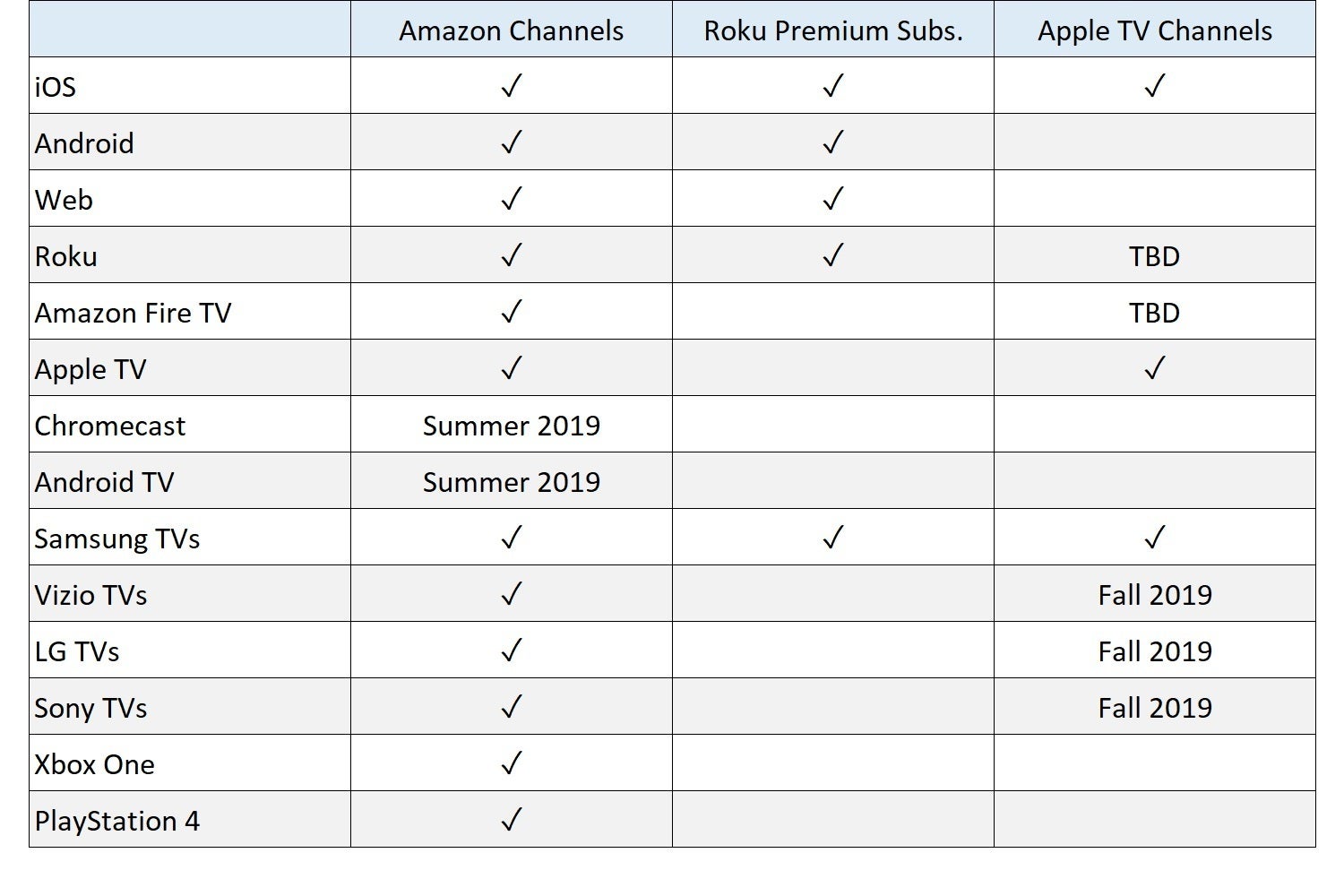
Jared Newman of TechHive reports that Apple TV has just launched “channels” too!

“With Apple TV Channels, you can sign up for services like HBO and Showtime directly through the TV app on iPhones, iPads, and Apple TVs. You don’t have to download separate apps to start using those services, and you can manage all their subscriptions through iTunes billing. Apple TV Channels also supports offline viewing on iOS, so you can download Game of Thrones episodes before your next flight.”

See his chart showing which platforms play which Premium Channel Services:
Macworld has a chart comparing the cost of AppleTV’s premium channels with the native apps, monthly and annually.

My take: this was bound to happen. As digital content continues to proliferate in apps from individual curators, forces of consolidation are appearing to counter the splintering of the viewing environment. It’s a battle between two or three big players to recreate your TV set of old within their app/device. I predict Netflix will go the Premium Channel Service route too.

Academy leaves Rule Two alone

Brian Welk reports in The Wrap that “the Academy of Motion Picture Arts and Sciences has opted against changes to Oscars eligibility that could have shut Netflix productions out of future ceremonies“.

The Academy’s Board of Governors upheld Rule Two, which states that a film must screen in a Los Angeles County commercial theatre for a minimum of seven days, with at least three screenings per day, in order to be eligible for Academy Awards.

They rebuked a proposed rule change by Steven Spielberg that would have seen streamed features restricted to television awards.

The 92nd Oscars will be handed out on February 9, 2020.

My take: when you realize the Academy Awards are a marketing vehicle for the film industry, this spat starts to make some sense. It illustrates the rift between the old guard and the technological innovators. I wonder how Spielberg will feel when Apple+ streams his projects.

Disney+ announced; enough is officially enough

Disney has officially announced the launch date of its new streaming service, Disney+.

The $6.99 a month service will be available in the U.S. on Tuesday, November 12, 2019.

It will include all of the Marvel, Pixar, Star Wars, National Geographic and Fox catalog. Disney tweeted:

“In year one, you’ll be able to rediscover more than 7,500 episodes and 500 films from our library on #DisneyPlus.”

In related news, Raymond Wong of Mashable complains that there are officially too many damn video streaming services.

PC Mag has a good chart comparing ten of the US streaming options.

My take: Over-saturation is becoming a growing problem. I can envision that folks will mix and match services each month, depending on what they want to watch; they won’t be as loyal as in the past. But this is a problem I think that will be eventually solved by an evolution of technology. Remember at the beginning of telephony that each town had its own exchange. These morphed from a maximum of 10,000 users per Central Office to today’s global networks. Likewise, I predict that content will one day flow directly from creators to viewers, bypassing curators. In the meantime, get ready to shell out the big bucks.

European Parliament bends digital single market for indie films

Scott Roxborough relates in The Hollywood Reporter that the Indie Film Business Wins European Territory Rights Battle.

Recall that European Commission President Jean-Claude Juncker had a vision where:

“…we must create a digital single market for consumers and businesses – making use of the great opportunities of digital technologies which know no borders. To do so, we will need to have the courage to break down national silos in telecoms regulation, in copyright and data protection legislation, in the management of radio waves and in competition law. If we do this, we can ensure that European citizens will soon be able to use their mobile phones across Europe without having to pay roaming charges. We can ensure that consumers can access music, movies and sports events on their electronic devices wherever they are in Europe and regardless of borders.”

This threatened the traditional country-by-country pre-sales strategy filmmakers have used to raise money for their budgets in Europe, fearing the digital single market would mean distributors could pay for one territory and get 27 for free. Roxborough first reported on this four years ago; see What’s Behind a Europe Plan That Would “Destroy” Independent Film.

Late last month, in the midst of Brexit, the European Parliament finally got around to approving this legislation, by a vote of 460 to 53. But with a few key compromises:

“The digital single market will apply to online services for news and current affairs — meaning the BBC or Italy’s RAI can offer their online reporting to anyone in Europe. The same applies to productions, including films and TV series, that are fully financed by a single network. But co-productions or films pre-sold in the traditional manner, as well as sports rights, are excluded from the new law. Here the old rules apply: online platforms will have to clear rights in each territory they want to operate in.”

My take: So it’s a blending of old and new. The “fully-financed” stream is interesting because I think it means rich producers (Netflix et al) will be able to treat Europe as one 500-million-viewer territory. Truly indie filmmakers though will still have access to traditional pre-sales, cobbling together an amalgam of territories, soft money and some actual investment in order to raise enough cash to shoot. I know which avenue sounds easier to me.

Indie filmmaking takes time, so have a day job

Part One: Claire J. Harris, writing in Noteworthy The Journal Blog, shares some Hard Truths About Making An Indie Film.

It boils down to all the time it takes:

“It may have been rather naïve to produce a feature film when I’d never even set foot on a film set before. How long could it possibly take, I asked myself, then decided the answer was definitely “No more than six months”. Reader, that was almost four years ago. We had six months of pre-production leading up to the shoot — but completing the film took another 18 months. Add three months to prepare our theatrical release, nine months of travelling with the film to Q&A screenings around Australia, and festivals interstate and overseas, then another few months to organise and promote the digital release. Throw in the two or so years I spent writing the screenplay and… I’m starting to find it difficult remembering a time when Zelos didn’t occupy most of my life.”

And all the the self-motivation required to finish:

“When you shoot and edit the film, you have people around you all doing their jobs (you hope) and driving the film forward with you. Then your cast and crew move on to their next projects and suddenly it’s just you, the producer, pushing the boulder up the hill on your lonesome. There’s no one to encourage you or to hold you accountable if you just… stop.”

Part Two: Chris O’Falt, writing in IndieWire, asks 30 SXSW Directors how they make a living.

Here are some of the answers:

  • I am a licensed realtor
  • Producing independent films
  • My family’s toy business Creative Director
  • I work as a writer and actress
  • I am a musician
  • I’m a faculty member at Columbia University’s School of the Arts MFA Film Program
  • I run a legendary karaoke RV, called the RVIP Lounge
  • Digital video editor and event producer
  • Playwright, teacher, and journalist
  • I DP independent films for a living
  • I’ve worked for a decade as a docent and live animal keeper at the American Museum of Natural History. I’ve spent three years in Germany as a falconer’s apprentice. And I’ve worked several years in a military post office. I also make animated, educational content for web channels like TED. And I have a secret life as a visual artist.

My take: I present these two stories together because they’re related. As Claire reminds us, indie films take years. And as Chris reports, most filmmakers need day jobs to keep money on the table; some are lucky to gig in the industry while others look for unrelated work. Making money with movies is indeed hard work.

Gravitas Movies becomes the latest streamer

Dave McNary reports, in an exclusive for Variety, that Gravitas Ventures has launched its own OTT streaming venture: Gravitas Movies.

President Michael Murphy says,

“At Gravitas we have always taken pride in being a distributor that can connect the artist and the consumer. By launching our SVOD service, we are taking the next step in bringing our vast young library of films to a global audience.”

Available now, the price is $4.99 monthly or $39.99 annually.

The service is built with Float Left‘s Flicast.

My take: Another one! And Apple has teased Apple TV+. Plus Disney is in the wings with their upcoming service. Really, how many streaming services do they think we can subscribe too? In a world with unlimited virtual real estate, everyone is building virtual digital cinemas/TV stations/nickelodeons hoping to attract our eyeballs. However, we all have limited attention, and pockets. In the analogue world, your choice of movie theatre was limited to ones in the vicinity; your TV set only picked up so many channels and what was playing was mediated by various levels of middlemen. Today, the trick for SVOD is to either go big or go small; have everything or only have one genre or otherwise appeal to a niche audience.

Sony Pictures Television Studios looking to cut costs

Ryan Faughnder reports in the LA Times that Sony Pictures is launching a specialty TV label for lower-cost shows.

ABSENTIA SEASON 2 PREMIERES JUNE 14th ON AMAZON!! ???????????????? All ten episodes of season two willdebut to Amazon Prime Video members in the US, UK, Germany, Australia, Austria, India, Israel, Italy, Netherlands,Singapore, South Korea, and other select territories globally. ???? ???????????? ???????????????????????????????????????????????????????????????????????????????????????? Please Check with your local providers for additional information on countries not listed. #Absentia Stana Katic Patrick Heusinger

Posted by Absentia on Thursday, March 14, 2019

Sony Pictures Television said it:

“…is launching a new production unit to make high-quality shows at a lower cost than the typical series, by taking a page from the indie film playbook. Jeff Frost, President of Sony Pictures Television Studios, told employees that the new label would focus on “producing distinct television programming in the indie feature film style.” The company expects to save money by filming in less expensive locations that offer production incentives, shooting more than one episode at a time and filming over shorter periods.”

This is the business model they used to launch Absentia on their worldwide network AXN.

It seems increased demand for quality television series has raised prices, so more integrated media companies are exploring ways to produce cheaper product.

My take: Did you know Absentia is shot in Bulgaria? I think the trend to more television, perhaps with lower budgets, shot feature-style is a good thing. It means more storytelling. So when you find something that clicks with you, you can immerse yourself into its world. It also means more work around the world for film craftspeople, which can only lead to more local indie work over time.

Filmocracy deserves your support

There’s an interesting project on Kickstarter I want you to seriously consider funding: Filmocracy.

Paul Jun and his team are developing a streaming platform for independent filmmakers that gamifies watching new movies and rating them.

Ratings won’t be simply thumbs up or thumbs down. Instead, viewers will be able to select 1-5 for:

  • Plot
  • Characters
  • Cinematography
  • Performances
  • Dialogue
  • Sound/Music
  • Overall

Half of revenue will be returned to filmmakers based on time screened with another 10% going to viewers.

Check out their pitch and please contribute.

My take: I think this is an interesting model that might just take off. Gaming is huge so why not gamify indie streaming? I’m a backer!

LG announces new Ultra Short Throw 4K projector

Will you still be on Santa’s Nice List in January?

LG will announce its latest CineBeam Laser 4K projector at CES 2019 in Las Vegas within two weeks.

The HU85L uses Ultra Short Throw (UST) technology that lets it project a 90-inch diagonal image when the unit is a mere 2 inches from the wall.

It can project a 120-inch image when placed 7 inches from the wall.

Here’s a review of last year’s model:

My take: Not cheap at something like $3,000 (3K for 4K?) but would mean you could dispense with a TV in your living room.

Netflix Canada raises prices amid more competition

Barely a year after it raised prices, Netflix is doing it again.

Netflix vs. Amazon Prime vs. Hulu Plus

The CBC reports that the streaming juggernaut will be upping prices by $1 or $3 per month, depending on the plan.

According to the CBC:

“Netflix says the move will help fund upcoming TV series and films as well as overall improvements to the Netflix platform.”

Recently, Bell Media doubled the price of its Crave streaming service to $19.98, now including Hollywood movies and HBO.

Emphasizing the shift to cord cutting, the CBC claims:

“Bell’s move marks the first time Canadians will be able to legally obtain new HBO shows without a cable television subscription.”

Also, on the horizon is the revamped Criterion Channel that…

“…will be picking up where the old service left off, programming director spotlights and actor retrospectives featuring major Hollywood and international classics and hard-to-find discoveries from around the world, complete with special features like commentaries, behind-the-scenes footage, and original documentaries. We will continue with our guest programmer series, Adventures in Moviegoing. Our regular series like Art-House America, Split Screen, and Meet the Filmmakers, and our Ten Minutes or Less section will all live on, along with Tuesday’s Short + Feature and the Friday Night Double Feature, and of course our monthly fifteen-minute film school, Observations on Film Art.”

For less than Netflix.

My take: Also in the wings are Disney’s standalone streaming service and Apple’s rumoured content hub. Obviously, it will get expensive to sign up for every streaming service out there. What will differentiate them? Ease of use, codec efficiency and, mainly, content exclusivity. 2019 will be the year the media landscape fractures into specialty outlets. Gone will be any semblance of one service for all audiences.