Cinema Under Fire: Ideology Threatens Expression

Ed Meza reports on Variety that Hostile Political Climate Threatening Cinema, Industry Representatives Warn at Zurich Summit.

Photo by Alisdare Hickson CC BY-SA 4.0 Activists gather at Piccadilly Circus in central London on Saturday 26 August 2023, despite the bad weather, to demonstrate against the continued imprisonment of Julian Assange and the US extradition proceedings. While the US government insists Assange is guilty of espionage, others maintain that he was acting merely as any honourable journalist should, by revealing the truth about US war crimes, the mass surveillance of entire populations and other crimes.

Zurich Film Festival‘s Zurich Summit 2025‘s Politics in Entertainment panel was held on September 27, 2025 and featured:

  • Moderator: Melanie Goodfellow – Senior International Film Correspondent Deadline
  • David Unger – CEO Artist International Group
  • Kathleen Fournier – Head of Production & Lead Producer Charlotte Street Films
  • Nathanaël Karmitz – Chairman of the Board mk2
  • Stephen Follows – Film Data Researcher and Consultant

To summarize —

Political Risks for Filmmakers: Filmmakers face mounting personal and professional danger when tackling politically sensitive material. Kathleen Fournier recounted moving her family and editing team to Berlin to finish her “Six Billion Dollar Man” documentary about Julian Assange, fearing U.S. and U.K. laws allowing footage seizure. As she put it, “There is substantial risk sometimes involved for me and my team personally.”

Erosion of Press Protections: Even nations with reputations for civic freedoms are showing cracks. Fournier’s relocation to Germany initially felt safer, but ongoing conflicts highlighted ideological pressures on journalists. “It was very interesting to see journalists challenged there in real time and to react to that,” she noted, underscoring the fragility of journalistic protections worldwide.

Far-Right Online Influence: The political climate extends into online discourse, where far-right voices dominate platforms like X. Nathanaël Karmitz warned this agenda seeks to undermine cultural institutions. “The far-right has become the major voice discussing cinema on X,” he said, pointing to organized criticism of mk2 events and ongoing attacks on French cultural bodies like the CNC. He asked, “How do we organize to fight back?”

Changing Media Landscape: The rise of streaming platforms has narrowed the opportunities for politically charged documentaries. Fournier observed that nuanced, complex stories struggle to get onto digital platforms, replaced by safer choices such as true crime or historical retrospectives. “The sort of documentaries you now find on streaming platforms tend to be historical… or very personal stories,” she explained.

Industry Courage and Activism: Panelists argued that today’s film industry often lacks the bravery of past decades. Stephen Follows criticized its timidity, calling it “fundamentally, as a business and as an ecosystem, risk averse and scared and cowardly.” He insisted courageous agitation is essential, reminding that movements like Me Too only emerged after activists forced accountability.

My take: do you feel a chill too?

Average Film Festival Fees

Stephen Follows has determined How much is the average film festival submission fee?

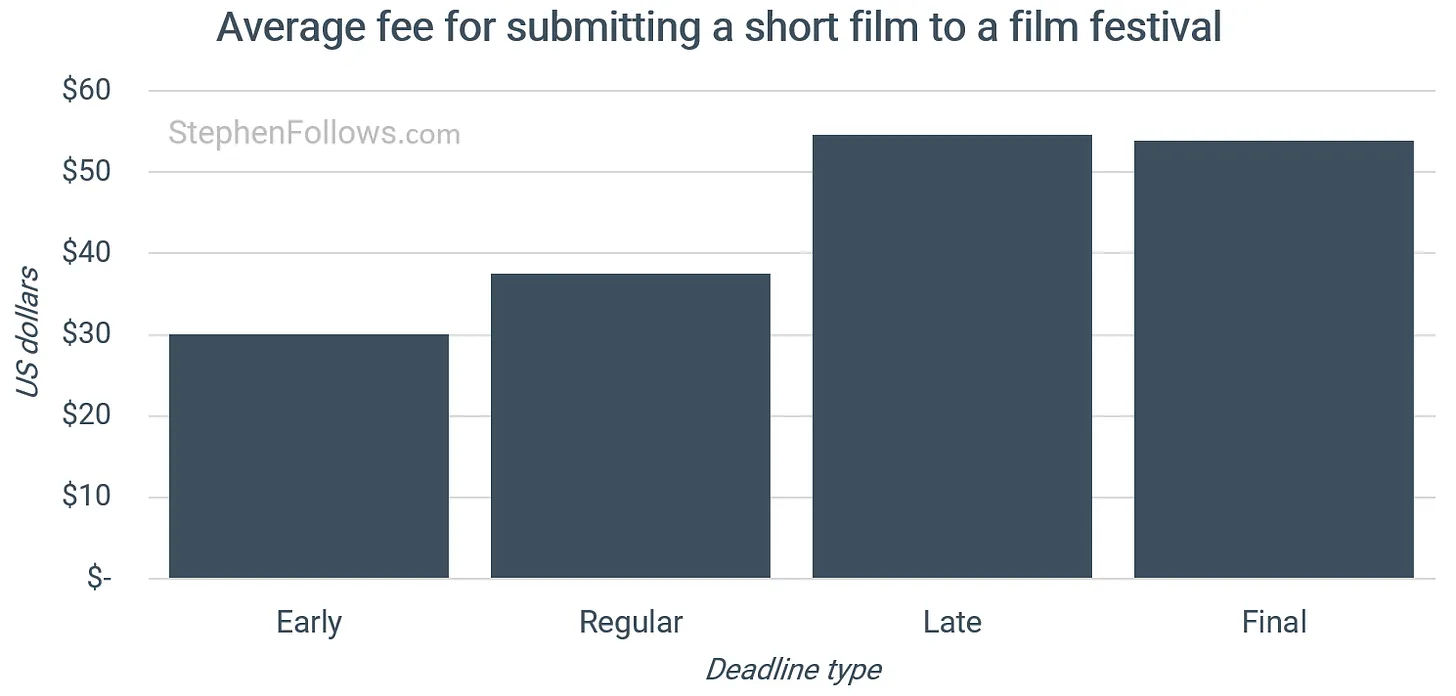
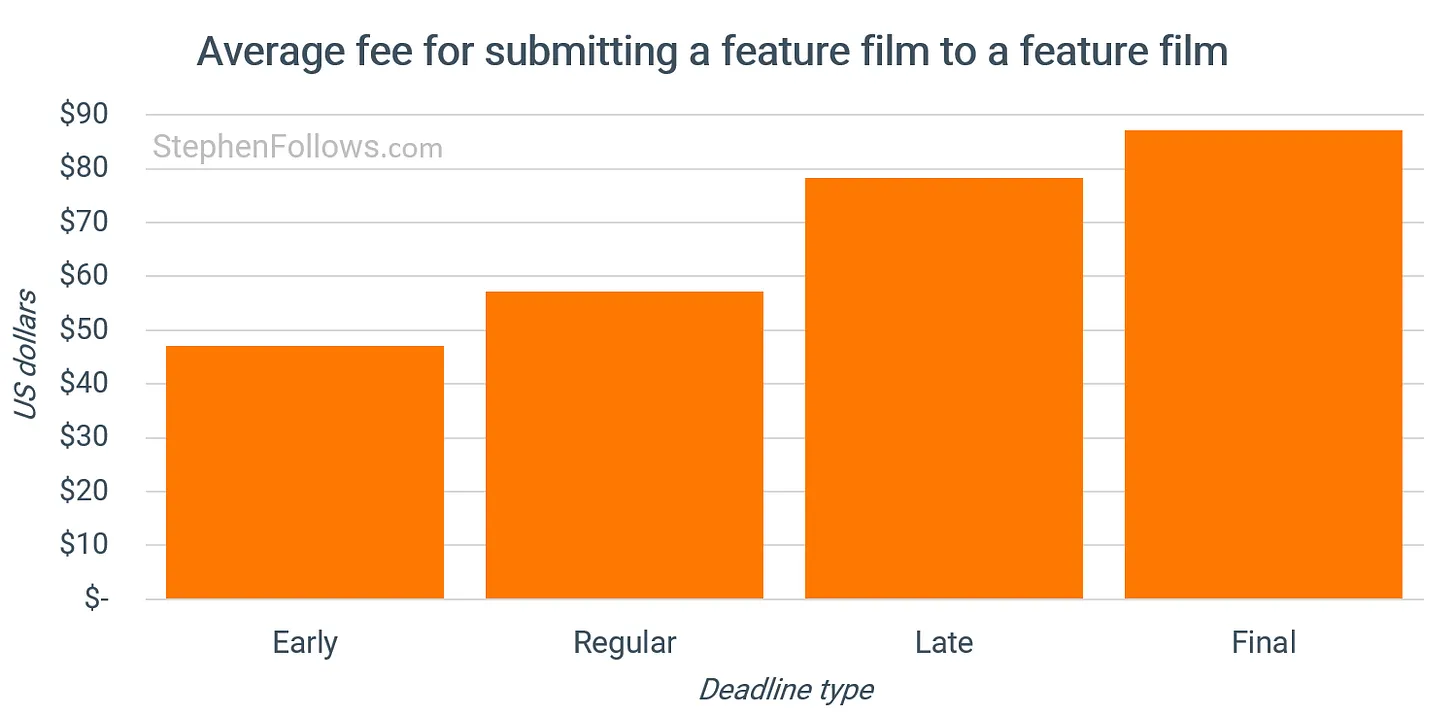
He checked out 4,631 film festivals and discovered that over half of them have more than 15 categories and hence fee levels. Reducing his scope to just Length (Shorts and Features) and Submission Deadline (Early, Regular, Late and Final,) he calculated that:

“The average submission fees for short films are between $30 and $55.

For features it’s between $47 and $87.

Why do festivals charge filmmakers submission fees? Stephen believes:

  1. Because running a festival is expensive. The majority are non-profits, both in the sense that they are registered charities and that they typically lose money each year.
  2. Because they know filmmakers will pay. A more cynical view of submission fees is that festivals are charging money based on the hopes and dreams of filmmakers.

Stephen concludes, “there’s no doubt that there are more than a handful of festivals outright exploiting filmmakers’ hopes and dreams via exorbitant submission fees.”

Figures are USD, btw.

My take: yes, these estimates feel correct. My conclusion is that, if only because shorts are on average one quarter (or less) the length of features, feature filmmakers are getting a break. Another way of looking at that is that short-filmmakers are subsidizing feature-filmmakers. (And no, I’m not taking about how tall filmmakers are — but it might be interesting to graph filmmaking success to height to confirm or deny a height premium. lol.)

What filmmakers really want to know on Reddit

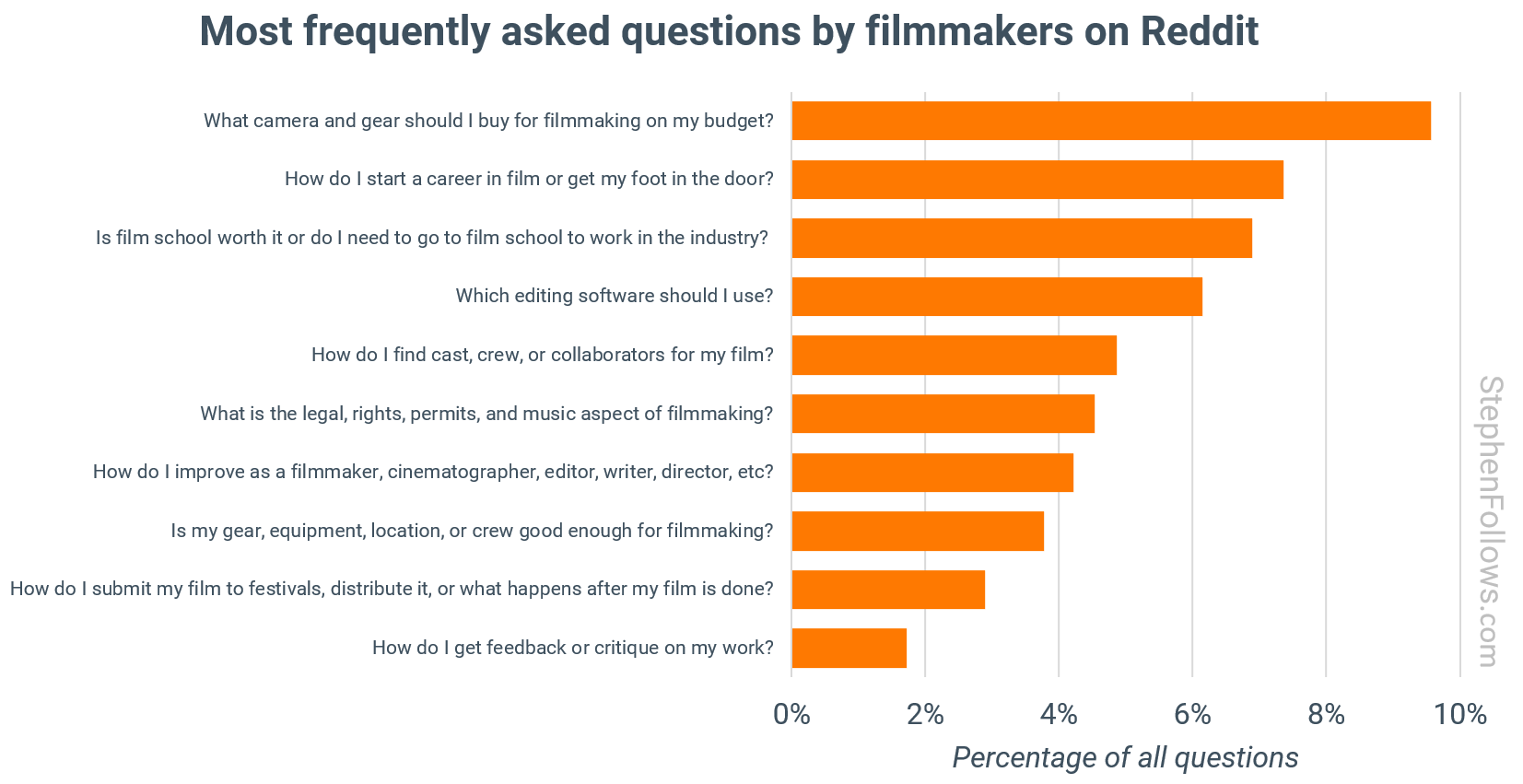
Stephen Follows analyzed over 160,000 questions on Reddit to uncover what filmmakers really ask, need and struggle with.

Amazingly, 10 questions accounted for 52% of the total. They are, quoting Stephen:

1. What camera and gear should I buy for filmmaking on my budget?

The search for the “right” camera and kit never ends, no matter how much technology shifts. People want to know what will give them industry-standard results without breaking the bank. The conversation includes price brackets, compatibility, and whether brand or model really matters to a film’s success.

2. How do I start a career in film or get my foot in the door?

This is the practical follow-up to the film school debate. Filmmakers want straight answers about first jobs, entry points, and which cities or skills lead to real work. Many people are looking for pathways that do not depend on family connections or luck.

3. Is film school worth it or do I need to go to film school to work in the industry?

Filmmakers want clarity on the value of a formal degree versus real-world experience. They are trying to weigh debt against opportunity and want to know if there are shortcuts, hidden costs, or alternative routes into the business.

4. Which editing software should I use?

Software choice raises both budget and workflow issues. Filmmakers want to know which tools are worth learning for professional growth. Questions focus on cost, features, compatibility, and what is expected in professional settings.

5. How do I find cast, crew, or collaborators for my film?

Building a team is a constant sticking point. Most low-budget filmmakers do not have a professional network and are looking for reputable ways to meet actors, crew, or creative partners. Trust and reliability are major concerns, as is the need for effective group communication.

6. What is the legal, rights, permits, and music aspect of filmmaking?

Legal uncertainty is widespread. Filmmakers are confused about permissions, copyright, insurance, and protecting their work and collaborators. They want step-by-step advice that demystifies the paperwork.

7. How do I improve as a filmmaker, cinematographer, editor, writer, director, etc?

Self-development is a constant thread. Filmmakers search for the best courses, books, tutorials, and case studies. Clear recommendations are valued and people want to know what separates average work from great films.

8. Is my gear, equipment, location, or crew good enough for filmmaking?

Questions about minimum standards reflect deeper anxieties about competing in a crowded field. People want reassurance that their toolkit will not hold them back and want to know how far they can push limited resources.

9. How do I submit my film to festivals, distribute it, or what happens after my film is done?

People want clear instructions on taking their finished work to the next level. Festival strategies, navigating submissions, and understanding distribution channels are a minefield. Filmmakers want to know how to maximise exposure and what steps make the biggest difference.

10. How do I get feedback or critique on my work?

Constructive criticism is in high demand. Filmmakers want practical advice on scripts, edits, and showreels. They look for honest reactions to their work and advice on how to keep improving.”

My take: my answers:

  1. The camera on your smartphone is totally adequate to film your first short movie.
  2. Make your own on ramp by creating a brand somewhere online with a minimum viable product – you need to specialize and dominate that niche. Or move to a large production centre.
  3. Maybe, if you can afford it and you’re a people person. Otherwise, spend the money on your own films because every short film is an education unto itself.
  4. Davinci Resolve. Free or Studio.
  5. Your local film cooperative. Don’t have one? Start your own.
  6. Google is your friend. Don’t sweat it too much (and create your own music) for your first short festival films. As soon as your product becomes commercial, you need an entertainment lawyer on your team.
  7. Watch movies, watch tutorials, make weekend movies to practice techniques, challenge yourself. Just do it.
  8. See Answers One and Seven. Note: this is an audiovisual medium; audiences will forgive visuals that fall short but WILL NOT forgive bad sound. Luckily, great sound is easily achievable today.
  9. FilmFreeway.com
  10. Send me a link to your screener; I’ll watch anything and give you free notes on at least three things to improve.

CineVic’s best film festival ever!

CineVic just concluded the best-ever Short Circuit Pacific Rim Film Festival in Victoria, BC, Canada, last weekend.

A new addition this year was Indie+Industry on the closing day that began with brunch at Vista 18 on top of the Chateau Victoria.

Then Johnny Brenneman and David Malysheff told us all about creating their new 8-episode series Bon Victoriage! for Telus Storyhive.

The next session saw Panta MoslehShiraz Higgins and Heather Lindsay share their experiences and hard-won wisdom.

The last panel saw Daryl Litke (ACFC West Local 2020 Unifor,) Wendy Newton (ICG 669,) Andrea Moore (DGC BC) and Michael Rosser (IATSE 891) explain the benefits of working with unions and guilds.

My take: I met great people and got some valuable feedback on my upcoming feature documentary. Definitely CineVic’s best film festival yet, and, finally, after years of contributing in various ways, I wasn’t involved at all.


CAPTCHA frustration film wins 2025 Oscar best live action short

I’m Not a Robot, a 2023 Dutch-language short science fiction drama written and directed by Victoria Warmerdam, has just won the 2025 Academy Award for Best Live Action Short Film.

It stars Ellen Parren as a woman who has an identity crisis after failing a series of CAPTCHA tests.

Watch the full short film here.

See trailers for all fifteen Oscar-nominated short films.

Check out more great short films in The New Yorker Screening Room.

My take: Great concept! And great production! Watching it, I wondered how they’d execute the “jumping” scene. (A oner with a quick pan away to substitute the stunt performer.) I accomplished something similar with edits only in dust2dust. Can’t wait to see what additional themes Victoria tackles in the feature-length version!

The Horror Movie Report just released!

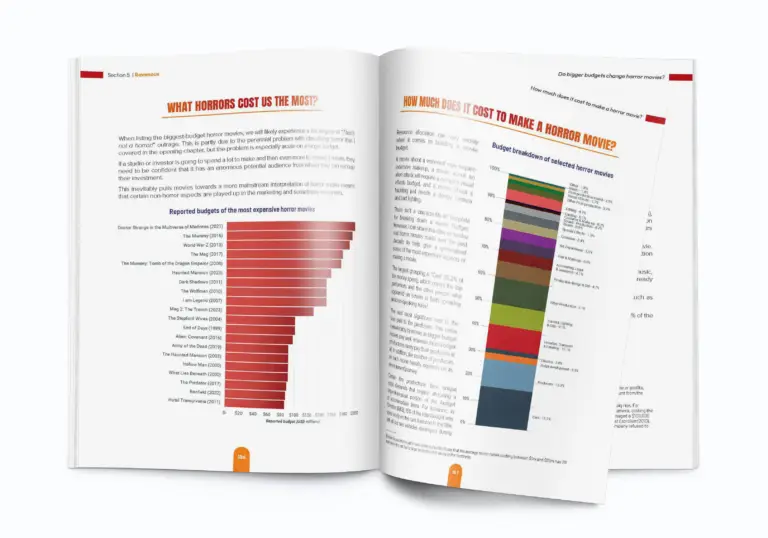
Stephen Follows has just released The Horror Movie Report, the most comprehensive case study of the horror genre ever, with data from over 27,000 films.

The report is offered in English and Spanish and comes in two editions:

  • Film Fan Edition is aimed at general audiences. (£24.99)
  • Film Professional Edition is designed for those in the film industry and includes extra insights on profitability, and budgets, and comes with all the data as spreadsheets. (£79.99)

At over 400 pages, the report contains chapters on:

  1. Horror Audiences
  2. Subgenres
  3. Script Origins
  4. Cast
  5. Crew
  6. Budgets
  7. Financials
  8. Box Office
  9. Profitability
  10. Other Income
  11. Film Festivals
  12. Post Production
  13. Posters and Marketing
  14. Objectionable Content
  15. Cultural Impact

Stephen is a leading film industry analyst known for his extensive research on film statistics; I’ve quoted his posts many times.

See the sample pages.

My take: Peter, this would make a great holiday gift for someone who aspires to produce a profitable film, no matter what the genre. The Professional Edition even comes with downloadable Excel files. Excel files!

September 8 deadline for CIFF Pitch Sessions

Folks who follow this blog, know that I love Telefilm‘s Talent to Watch competition. It remains your best chance at funding your first feature film in Canada.

Until they allowed direct submissions from underrepresented folks two years ago, this is normally a two-stage process. Each of approximately 70 industry partners get to forward one (and sometimes two or three) projects to Telefilm and then the Talent to Watch jury selects eighteen or so for funding.

The prize? $250,000. One quarter of a million dollars.

Don’t belong to one of the Industry Partners? No problem!

The Chilliwack Independent Film Festival has got you covered. Launched last year, Pitch Sessions lets you throw your first feature project into the ring; five are selected to then pitch in person at the festival and the winner becomes CIFF’s nominee to Telefilm’s next Talent to Watch competition.

Oh yah, the top five also get free passes and a hotel room for the festival.

The deadline to apply to Pitch Sessions at the 2024 Chilliwack Independent Film Festival is September 8.

My take: If you’ve got a spare $100 and you want to hone your pitch in public, this is a great opportunity. Note that each industry partner sets their own rules but this is the only one I know of that incorporates a live pitch. Just be aware that Telefilm typically doesn’t open the Talent to Watch competition until mid-April.

Deadline approaches for women to apply to BANFF Spark

The application deadline for this year’s BANFF Spark Accelerator for Women in the Business of Media: Producers Edition is rapidly approaching: August 12, 2024.

BANFF Spark provides market access, training, and networking opportunities to help build more Canadian women-owned media businesses.

“Since the program began in 2019, BANFF Spark has already provided opportunities for more than 200 women entrepreneurs. The program is open to all candidates and is designed to empower women of colour, Indigenous women, women with disabilities, 2SLGBTQI+ women, and non-binary individuals.”

All selected participants will receive:

  1. Online workshops (that address the core components of business development).
  2. Networking opportunities with top industry professionals.
  3. A full-access pass to the 2025 Banff World Media Festival (June 8-11, 2025) and its complement of top industry sessions and international marketplace.
  4. A $1500 CAD travel stipend to attend the 2025 Banff World Media Festival
    (on the condition of in-person Festival attendance).

Apply here.

My take: I love that this is focussed on people and not squarely on projects. I don’t have to mansplain this, just apply!

Nemo breaks The Code to win Eurovision 2024

Last weekend Switzerland‘s Nemo won the Eurovision Song Contest in Malmo, Sweden.

Wow! What a song! What a voice! What staging! What lighting! What direction! All culminating in the win!

Leonor Gomes, writing in D5 MAG, treats us to A Little Amuse-Bouche of Eurovision 2024’s Stage Lighting Design.

In it we learn some of the technical details: “Movable LED cubes, LED floors, light, video, and stage technology will be combined to create dynamic and customisable-to-the-brim variations in the arena. The stage is placed right in the middle of the audience, in a cross-like shape, giving people a 360-degree experience where lighting design, music, and performances are not just seen and heard but felt.”

Over at the European Broadcasting Union official site, more details abound:

  • over 400 radios and 200 intercom panels
  • more than 60 radio channels, both analogue and digital
  • 196 variable speed hoists used to position and move the lighting and LED elements in the design
  • 204 tons of technical gear suspended from the arena ceiling, supported by 3.5 km of truss
  • over 2000 light fixtures, each with LED or laser sources
  • approximately 1000 square meters of LED screens enveloping the set, from the stage floor to LED video cubes
  • 68 speakers
  • 56 microphones
  • 9 sound desks
  • 3 different sound mixes, including in-ear monitors for artists, PA for the on-site audience, and the broadcast mix for TV viewers worldwide
  • 55 seconds to move each prop into place while simultaneously rolling another off the stage
  • over 1000 accredited media representatives from around 60 countries

The Eurovision site names the two people most responsible: Florian Wieder and Fredrik Stormby.

Take a look at the incredible live Steadicam work during the French song:

My take: I love this show and watch it each year. I love the now-permanent slogan: United by Music.


The FCC complaints regarding John Cena presenting at the Oscars

Kory Grow reveals in Rolling Stone what the Three People [who] Did Not Enjoy John Cena’s Physical Perfection at [the] Oscars wrote.

He begins with the admission that “Rolling Stone was able to review the irate messages via a Freedom of Information Act request.”

One wrote:

“Indecent Prime Time TV: There is no reason why a grown man will come to national television like a streaker and molest and abuse all the children who will hear and see this in TV and in the various media the following day. There is need for Cena and the Oscar organizers to be cancelled for promoting gratuitous and inappropriate nudity in such horrific levels that they deserve boycott in the first order.”

Another wrote:

“What more can I say….other than an undresses [sic] man coming out on stage with only and piece of paper covering his private parts! Do your job! Get this filth off our TVs!”

A third wrote:

“Double standards with nudity: John Cena’s almost-complete nudity during the Oscars on March 12th, 2024, was abhorrent. If that had been a woman, the world would have ended.”

Riley Utley reports on Cinemablend that the Academy specified that “a bulge cannot be showing, and you can’t show crack.”

No crack proof.

Watch the costume change.

My take: lol! The world did not end. In fact, it was one of the high points of the broadcast. Perhaps those three were just jealous?