Inside the film festival selection process

Caleb Hammond, writing in MovieMaker, reveals How to Get Your Film Into Festivals.

Illustration by Angela Huang

The article summarizes responses from “a range of festival directors (many with 10-plus years of experience), programmers, and of course, screeners” to a detailed survey.

Having been a screener and member of programming committees for a number of film festivals, I’ll also chip in.

Do screeners watch every minute?

“44 percent of screeners made clear that they watch every submission to completion. Thirty-seven percent said they occasionally fail to finish viewing a submission and only 19 percent said they frequently stop a film submission early.”

I watch every minute, unless a submission is so terrible or clearly outside a festival’s field of interest.

Should my film be long or short?

The consensus is that shorter is better. Remember, the shorter the films, the more that can be programmed.

I agree. I watch hundreds of films so I’d rather watch two shorter films than one longer one. Put another way, a longer film has to be significantly better than two shorter ones to make it.

Will a film festival bend its rules for me?

Do your research and “really know the profile of every festival you consider submitting to.” This way you can save time and money by avoiding submissions to unsuitable festivals.

Make sure you check off every requirement of the festivals you submit to — no exceptions. Bonus: help me make sure your film qualifies if there’s any question about any of the requirements by explaining everything to me in your personalized cover letter.

Will festivals let my bad sound pass?

No. Bad sound is a tip off, like bad acting and bad visuals, of a bad film. Anything sub-standard makes it much tougher to accept a film. Paradoxically, casting a known actor in your film may actually raise the bar for all the other aspects of your film.

I agree. Bad sound is hard to ignore. I would almost suggest doing one or two takes of every scene close-mic’ed without camera to give yourself plenty of sound options in edit (before resorting to ADR.)

Can diversity help my film?

Yes. If two films are tied, the one with more diversity wins.

I look for diversity in both the cast and the crew.

I missed the deadline. Can I submit after the late deadline?

Maybe, but it’s not recommended. Submit as early as possible for a couple of reasons. Earlier submission costs are cheaper than later ones. Plus the later you wait, the greater the chance that a festival has already started to make decisions. Even if they haven’t, your late film is subconsciously judged agains all that have been seen before it.

I advise that you do not send a work in progress because you are asking the festival to make a couple of gambles on you and your film: will you or won’t you finish the film in time and will it or won’t it be better than other finished films that could have been chosen? Better to not rush it and submit next year when the film is completed.

I love these closing words, quoting an anonymous programmer:

“There’s a festival for every film and a film for every festival. Submit to the ones whose vision you agree with and want to support, whether you’re accepted or not.”

My take: Make the best film you can. Know your ideal audience. Research appropriate festivals on FilmFreeway. Offer your film to those festivals for their programs. If your film is selected, congratulations! If it isn’t, feel good in supporting those festivals. Continue to believe in your film and realize it wasn’t a good fit with their programs. Make better films, and repeat this cycle. Nevertheless, if you go through this loop too many times, consider starting your own film festival!

Academy leaves Rule Two alone

Brian Welk reports in The Wrap that “the Academy of Motion Picture Arts and Sciences has opted against changes to Oscars eligibility that could have shut Netflix productions out of future ceremonies“.

The Academy’s Board of Governors upheld Rule Two, which states that a film must screen in a Los Angeles County commercial theatre for a minimum of seven days, with at least three screenings per day, in order to be eligible for Academy Awards.

They rebuked a proposed rule change by Steven Spielberg that would have seen streamed features restricted to television awards.

The 92nd Oscars will be handed out on February 9, 2020.

My take: when you realize the Academy Awards are a marketing vehicle for the film industry, this spat starts to make some sense. It illustrates the rift between the old guard and the technological innovators. I wonder how Spielberg will feel when Apple+ streams his projects.

Spielberg wants to make it harder for Netflix to win a best picture statuette

Zack Sharf reports on IndieWire that Netflix has responded to Steven Spielberg’s lobbying for rule changes (that would make it harder for the streamer to win more Academy awards) with a tweet:

From the Orlando Sentinal:

“Spielberg, an Academy of Motion Picture Arts and Sciences governor representing the directors branch, reportedly is planning to propose rule changes that would prevent streaming services such as Netflix, Amazon and Hulu from competing in the Academy Awards without their projects getting a full theatrical run first.”

He makes his case next month, per Anne Thompson:

“Last Thursday, an Amblin spokesperson confirmed that Academy governor Spielberg will bring up at the next Board of Governors rules meeting in April proposed changes that would force streamers such as Netflix to fulfil a more robust theatrical distribution requirement than the 2012 rules demand to qualify for Oscar consideration. It’s not at all clear that Spielberg has enough backing from the 54-member board to put through those rule changes.”

Netflix has won many awards, including their first Academy Award in 2017.

My take: I think Spielberg is afraid of change and the massive buying power of the streaming platforms. He loves movies and cinemas. I too would hate to see the theatre-going experience fade away. But that’s partly the film industry’s fault since they put so much emphasis on movies based on comic books. Imagine how interesting cinemas would look like if comic book movies were banished to TV.

FilmFreeway defeats Withoutabox

Chris O’Falt reports on IndieWire that FilmFreewaywill not use its position to force festivals into exclusive arrangements,” the tactic that Withoutabox thought would ensure its survival.

Last week Withoutabox unexpectedly announced that it would be shutting down within a year.

O’Falt quotes Andrew Michael:

“While we love it when festivals choose to use FilmFreeway exclusively, we never require exclusivity and we never will. Festivals should have complete autonomy as to how they run their events and the services they choose to help them reach filmmakers. We don’t believe in the approach that WAB used to lock up festivals exclusively with secret contracts. We’ve always believed that if we provide festivals with a high quality product, personal customer care, and a world-class user experience they will continue to happily utilize FilmFreeway to facilitate and manage their submissions.”

O’Falt sketches a brief history of WAB and its issues.

He then reveals some welcome news from FF:

“Recently, the company started offering festivals the ability to sell tickets on FilmFreeway with no fees, and is getting ready to create a free-of-charge DCP creation tool for customers. This week, FilmFreeway plans to announce a price reduction.”

My take: I’ve used both services and withoutadoubt FilmFreeway is better than Withoutabox. I think the only benefit WAB provided was that your film would get a listing on IMDb. Soon, you’ll have to do that manually. 8-(

A New Release Strategy for your Short Film

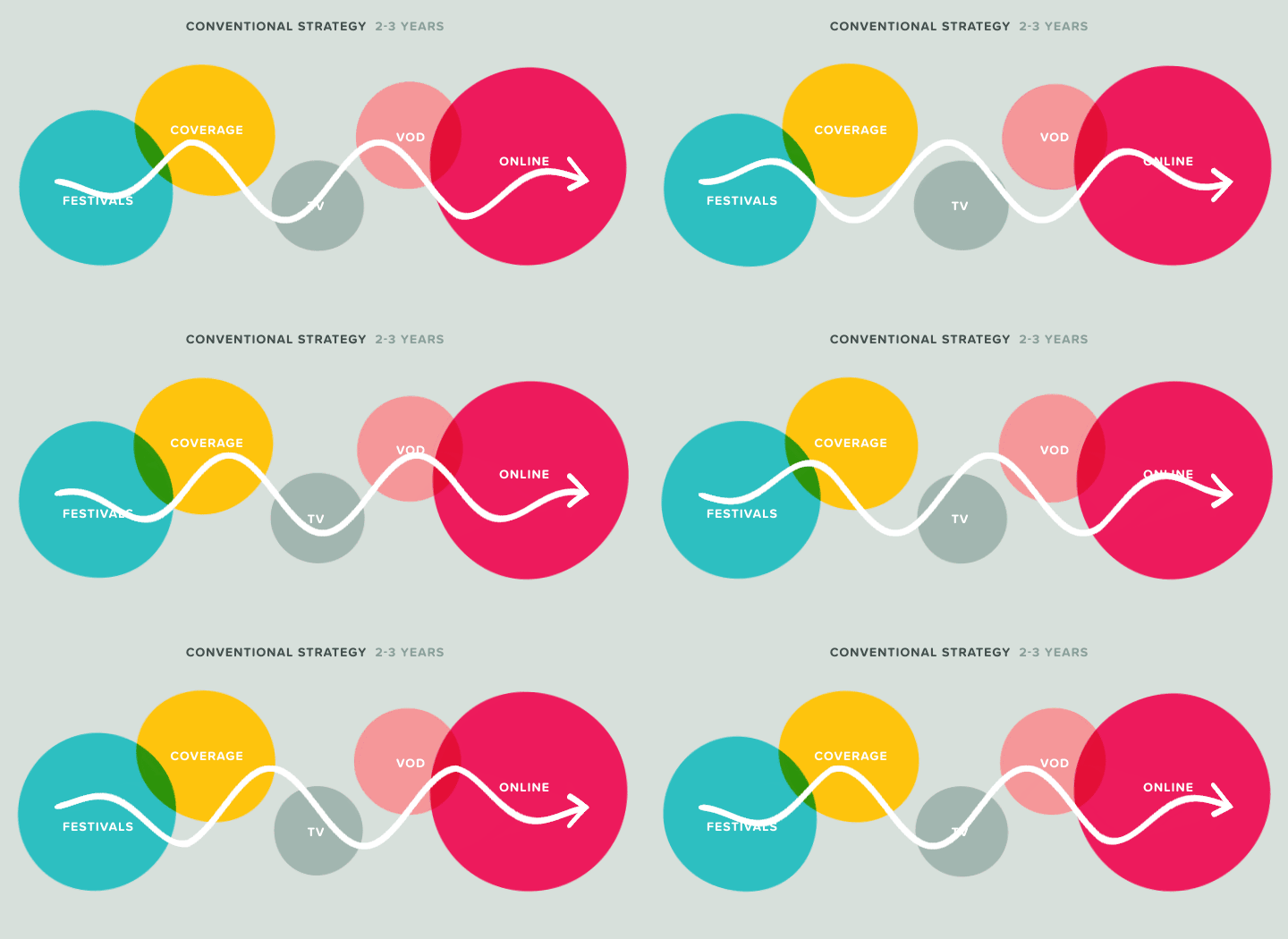
You’re proud of your short film! You want to launch it into the world so you create a release strategy. Typically, it looks like this:

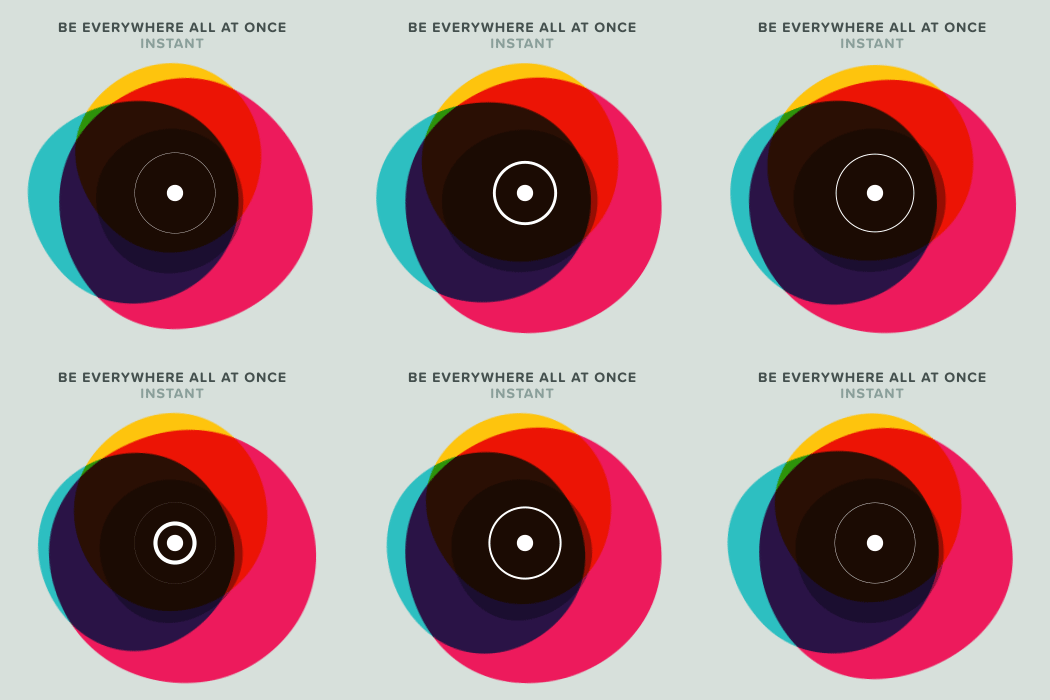
Andrew S. Allen, of Short of the Week, thinks it should look like this:

He’s arguing from a partisan position because he’s part of an online festival that can premiere your short, but I think he make a lot of sense.

He even has survey results and statistics to back up his assertions.

In a nutshell, he suggests:

  1. Create an online + festival strategy. Submit your film to online outlets early.
  2. Secure your premiere with a top tier festival or online site.
  3. Find partners — connect with curators to reach their audiences.
  4. Don’t prioritize money — it’ll likely hurt your exposure.
  5. Don’t sign away exclusivity — hang on to your right to ‘be everywhere’.
  6. Go cross platform and get your film everywhere.
  7. Internationalize your film with subtitles to reach even further.
  8. Compress your release window over days/weeks rather than months/years.
  9. Launch, engage and recalibrate during the week of your release.
  10. Be prepared to pitch your next idea or project.

My take: once upon a time, the mediascape was an orderly grid: on one axis you had ‘windows,’ a hierarchy of platforms (theatrical, pay TV, airlines, free TV, libraries, etc.,) and on the other axis you had ‘territories,’ geographic regions (North America, Europe, Australia and New Zealand, Asia, Africa, etc.) Then along came the Internet that blew away time and space. The ‘Conventional Strategy’ above harkens back to the time of the Old Mediascape. ‘Be Everywhere All at Once’ is firmly rooted in the digital New Mediascape. One great reason to adopt it: you never were making any money from your short, so you might as well get it over with with the BEAAO Strategy and save yourself a couple of years. After all, time is money.

How to Choose the Best Picture Oscar

The Academy of Motion Picture Arts and Sciences held the 80th Oscars last Sunday.

The Creature from the Black Lagoon

Guillermo del Toro‘s “The Shape of Water” won Best Picture.

Going in, I thought “Dunkirk” and “Three Billboards outside Ebbing, Missouri” were the front runners, with “Lady Bird” a close third. “Get Out”?

But can the winner be predicted?

Youyou Zhou, writing on Quartzy, offered The Ultimate Statistical Model for Predicting the 2018 Academy Awards Best Picture.

She rated the nine nominations on four scales:

  1. Buzz and fanfare
  2. Prior awards
  3. Money talks
  4. Critic reviews

She then asked the reader to weigh each category to produce a prediction.

Of course, we now know the actual winner, so we can reverse engineer this to gain some insight into what’s important in winning Best Picture.

I played around with the sliders and came up with:

  1. Buzz and fanfare = 15%
  2. Prior awards = 70%
  3. Money talks = 10%
  4. Critic reviews = 22%

I know it adds up to 117% — hey, I didn’t build this.

The biggest predictor was Prior Awards. In fact, “The Shape of Water” wins with all the categories at 25% and Prior Awards at 100%.

This graphic illustrates the favourites on each of the four scales.

My take: This just begs the question, how do you predict the other awards shows?

Digital Box Office streams indie flix for free

This week I’m seeing a lot of ‘sponsored content’ posts for a new service called ‘Digital Box Office‘. (However, this is not a paid for post.)

“Developed by Hollywood Insiders and launching in early 2017, Digital Box Office is a groundbreaking global film platform that supports and caters to filmmakers as its #1 priority. Built on the latest state of the art infrastructure and incorporating the most sophisticated technology, Digital Box Office offers an unparalleled opportunity for film viewers to watch content in the highest quality viewing experience possible. Not only will your film have the capability to immediately reach millions of consumers globally, your film will also be seen by a community of some of the most important decision-makers in Hollywood. Digital Box Office is where many of today’s Hollywood rainmakers will be scouting their next big film project and talent. Digital Box Office is the first and only service of its kind.”

The platform is free to all; create an account, watch shorts and features, and then rate them out of five popcorn servings to carry on watching more.

Digital Box Office is also a film festival. Happening on May 11 and 12 in Los Angeles, the plan is to make this an annual offering. There is $25,000 in prize money:

“Digital Box Office will support the independent filmmaker community by offering a cash prize of $10,000 to the filmmaker with the top performing film on DBO each year. In addition, the filmmaker with the top performing film in each category and our top performing student filmmaker will each receive a cash prize of $5,000 dollars.”

Filmmakers can submit films for inclusion. DBO wants a non-exclusive 90 day window, after which the film is taken down.

My take: With less than a thousand films on the platform now, there’s an opportunity for indie filmmakers to get exposed here. If DBO gets traction, this could be a great thing. I do think the search tools on the site need some beefing up. Otherwise, it has potential and you might want to consider it in your distribution plans.

Festivals for Web Series

Once upon a time, one way to attract attention to your independent film was to exhibit it on the festival circuit.

The idea was that appreciative audiences would prove your film’s worth to distributors who would then pay you to buy your film.

Fast forward to today. There are thousands of films being made each year. Sundance receives over 12,000 submissions and can show only 185.

Okay. So let’s make a web series instead.

We still face the same problems: how to attract an audience and how to get paid.

Enter festivals exclusively for web series.

The excellent CMF Trends has just published a listing of 45 festivals for web series.

“Given the perpetually increasing offer of quality productions, ‘discoverability’ remains one of the main challenges that webseries creators face. What can creators do to make sure their projects stand out from the competition? Among the options that are available to them, they may enter their work in national and international competitions.”

This list includes:

  • 12 in Canada
  • 14 in the United States
  • 13 in Europe
  • 3 in Asia and Oceania
  • 3 in Latin America

The big winner seems to be Montreal with six!

My take: how do you show a web series at a festival? Binge watch all ten webisodes?

CMF lists support for Canadian exports

Amidst a background of reflection on Canada’s cultural place in a digital age, the Canada Media Fund has published a list of federal and provincial support for audio-visual exports.

The 10-page PDF list 6 national and 19 provincial programs, ranging from 1 in Yukon to 4 in Ontario.

For instance, Telefilm Canada‘s International Marketing Program:

“…seeks to support the marketing of Canadian feature length and short films that have a huge potential for success. Supports the international promotion and marketing strategy for Canadian productions officially selected to be presented during a recognized international festival. Nature of the assistance: Non-reimbursable contribution that can reach 100% of eligible costs, up to a cumulative maximum of $40,000 per eligible production.”

My take: as we look beyond our borders, this is handy information.

Zapruder Films seeks Canadian female feature writer for dev deal

Because they don’t feel the Canadian feature film industry is doing enough to bridge the gender gap, Matthew Miller and Matt Johnson of Toronto’s Zapruder Films have launched a program to help support the development of one emerging female screenwriter.

They will be giving all of their $12,000 Telefilm development funds to one woman to develop a treatment into a first draft narrative feature script.

The rules:

“The contest opens September 8, 2016 and closes September 18, 2016.
The winner will be announced on Friday, September 30.
Applicants must not have written a produced feature length screenplay.
Scripts must be the original work of a female writer and must be written originally in English. Adaptations and translated scripts are not eligible.
The writer must be a Canadian citizen or permanent resident.
The writer must agree to option the material to Zapruder Films for a 24 month period.
The writer must not be a member of any screenwriting unions or guilds.”

Your single PDF application must be at least seven pages:

“One page synopsis of the film
A short treatment of the film (5-10 pages)
A short brief addressing what your film means to you (300 word maximum)”

I asked Matthew and Matt what sort of response their program has received:

“The response has been really encouraging. There have already been several submissions and dozens of inquiries as to the specifics of the rules and regulations. For the most part, it is very hard for young writers without an agent to get their foot in the door. Most companies don’t accept unsolicited works so we think that alone has provided a breath of fresh air. And it is trying to help address the issue of gender disparity in our industry and that has helped to spawn a healthy and spirited debate on social media. We couldn’t be happier with where things are at this early in the program.”

My take: I applaud Zapruder Films for this program. It’s smart on two counts: firstly, they’re addressing the gender imbalance in the Canadian feature film industry. Hey, it’s 2016 already. Secondly, these guys want to encourage new, as-yet-unheard voices, with new, interesting stories to tell. As we all know, story is king, or in this case, queen.