Streaming strengthens

As Netflix releases the first trailer for its most expensive movie to date at San Diego’s Comic Con ($90 Million USD for Bright, starring Will Smith), CMF Trends explores the flourishing streaming world:

They claim one out of three homes are watching Netflix every night; one out of six are watching Youtube; and one out of 25 is watching Amazon.

“In 2016, the consumption of audio and video content amounted to 71% of evening online traffic on fixed broadband networks in North America according to Sandvine. This proportion has doubled in the past five years…. The spending shift towards streaming services can also be observed in Canada, where spending on Internet access has been higher than spending on cable TV subscription since 2015.”

The cost of all that content is exploding on an upward curve as well:

For instance, prices paid for comedy specials have doubled:

My take: I’ll tell you what drove us to Netflx: TV commercials. We didn’t mind appointment viewing for the new shows we liked but the commercials became too intrusive for all but live events (like sports and award shows). And on Netflix, if the story really grabs you, you can binge watch multiple episodes.

How to encode movies in cells using DNA

As reported widely last week, Seth Shipman, from Harvard Medical School, has used CRISPR-Cas technology to encode a 36 x 26 pixel movie into the DNA of living E. coli bacteria.

“The mini-movie, really a GIF, is a five-frame animation of a galloping thoroughbred mare named Annie G. The images were taken by the pioneering photographer Eadweard Muybridge in the late 1800s for his photo series titled ‘Human and Animal Locomotion.'”

They explain it all in a bigger movie:

They hope to turn cells into living recorders to store information from the immediate environment.

Curiously, the scientists who did this in March of this year don’t seem to have received much coverage. And they accomplished much more: encoding, among other things, a gift card and a computer virus. Obviously, the Harvard brand has better publicists.

And similar feats have been done before. IBM spelled out its name in atoms in 1989.

My take: this is just a stunt to prove we can encode information in DNA, something Mother Nature has been doing for billions of years. But of course, let’s not forget the unintended consequences. When you mess around with Mother Nature, things don’t always go as planned. Imagine encoding ‘Godzilla‘ — and then the DNA mutates!

Interactive video comes to Netflix

Casey Newton reports on The Verge that Netflix is testing interactive video with half its audience — kids.

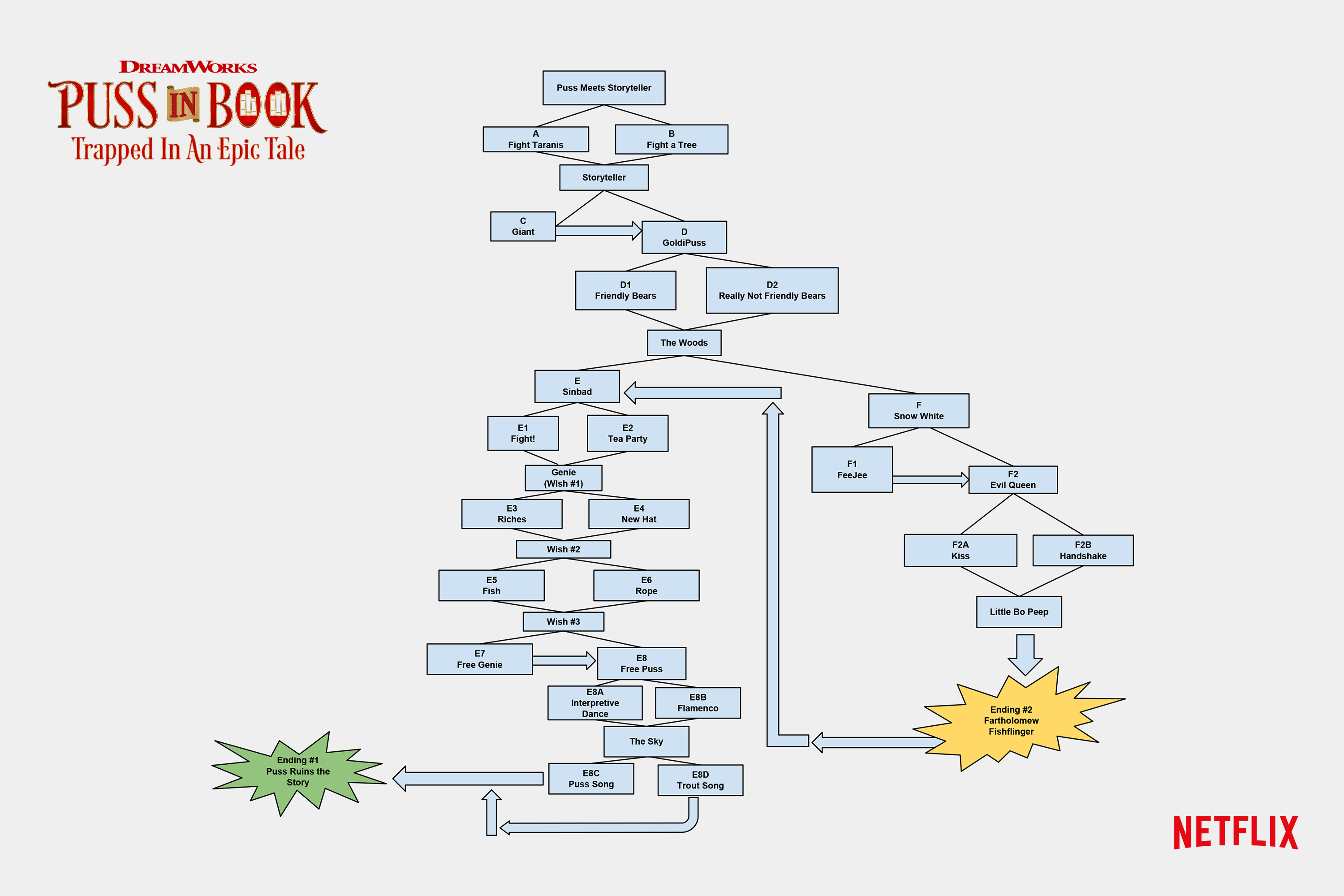
The first title is Puss in Book: Trapped in an Epic Tale.

Carla Engelbrecht Fisher, Netflix’s director of product innovation, says:

“Kids are already talking to the screen. They’re touching every screen. They think everything is interactive.”

The result is a branching story that results in varying viewing lengths of 18 to 39 minutes.

A second title will have a simpler structure with four endings:

Note that Netflix has not invented branching stories — Choose Your Own Adventure published 250 million gamebooks over two decades in the previous millennium.

My take: it’s interesting that Netflix only has the technology working on half of their platforms. Nevertheless the potential is seductive. Think of the dramatic possibilities: “Feeling lucky, punk?” or “You take the blue pill—the story ends, you wake up in your bed and believe whatever you want to believe. You take the red pill — you stay in Wonderland, and I show you how deep the rabbit hole goes.” One thing writers will have to get used to is the cavalier ease at which the audience will be able change the narrative — kind of like print designers had to let go of exact specificity when the web came along.

Truth is stranger than fiction

I wrote the first draft of my first spec feature film script, the very black comedy 2020 Vision, back in a blitz during the winter holidays at the end of 2009. I had ten days, so my goal was to write ten pages a day.

No doubt influenced in part by The Simpsons, it featured a body-less man who woke up from a coma to find his wife sleeping with his ex-business partner —  but first in order to fight for her he had to find a new body.

Fast forward to 2017.

Later this year, Italian scientist Dr. Sergio Canavero intends to be the first to perform a human head transplant.

Little does he know I predicted this procedure; see the scene at the bottom of page 63. And I didn’t have the benefit of this scientific review.

My take: the question is not really whether truth is stranger than fiction, but rather if this neurosurgeon’s claim is truth OR fiction. I may have predicted one thing, but The Simpsons have accurately predicted the future more than a dozen times.

Google promotes VR180 on Youtube

Frank Rodriguez, Google’s VR Product Manager has posted The world as you see it with VR180 on both Google and Youtube.

“VR180 videos focus on what’s in front of you, are high resolution, and look great on desktop and on mobile. They transition seamlessly to a VR experience when viewed with Cardboard, Daydream, and PSVR, which allow you to view the images stereoscopically in 3-D, where near things look near, and far things appear far. VR180 also supports livestreaming videos so creators and fans can be together in real time.”

There are two main differences between 360 Video and VR180:

  • VR180 lacks the ‘back 180’ (which can therefore allow for higher resolution up front)
  • VR180 is stereoscopic, using two lenses to create true 3D, from the camera’s fixed point of view.

In addition, Google announced that they want to help build new VR180 cameras, initially partnering with Lenovo, LG, and YI Technology. Team Lucid tells me, “We hope to be the first certified camera for this program and will be sending updates via social on our progress.”

See the VR180 playlist on Youtube’s official Virtual Reality channel.

My take: glad to see Google/Youtube agree with me: 3D VR180 is a friendlier  version of 360 Video and true Virtual Reality. My only concern is that for browsers, be they web or mobile, they’ve removed the mouse or keyboard controls; the immersive goodies are for VR headsets exclusively. However, for a filmmaker like me who likes to shoot on a tripod, this promises to be the best of both worlds.

360 Video Heatmap Analytics

In your 360-degree and VR videos, the audience can look almost anywhere. You might hope they’re looking over here, but what if they’re looking over there?

Now there’s a way to find out where viewers are looking.

Youtube Creator Blog has just posted Hot and Cold: Heatmaps in VR .

“Today we’re introducing heatmaps for 360-degree and VR videos with over 1,000 views, which will give you specific insight into how your viewers are engaging with your content. With heatmaps, you’ll be able to see exactly what parts of your video are catching a viewer’s attention and how long they’re looking at a specific part of the video.”

Some key findings based on their research:

  • People spend 75% of their time within the front 90 degrees of a video.
  • Almost 20% of views are directly behind.
  • Mobile viewers using Google Cardboard need a couple of seconds to get situated before the action starts.

They also suggest: “Try using markers and animations to draw attention to different parts of the scene.”

My take: these analytics are golden if you’re making immersive video. My advice is to map out where you think attention will linger and then compare it with actual results. This should help you refine your content. In addition, I feel these findings bolster my contention that 180-degree 3D immersive video is superior to flat 360 for narrative immersive video.

Creature feature launches Dark Universe

The Mummy not only wants to be a critical and financial success.

It also seeks to launch the Universal Studios‘ storyverse called the Dark Universe.

In addition to The Mummy, the Dark Universe will include, according to director Alex Kurtzman speaking to Fandom:

“We know we’re going to do Frankenstein, Bride of Frankenstein, Dracula, Creature from the Black Lagoon, Phantom of the Opera, Hunchback of Notre Dame, and Invisible Man…. There are characters within those films that can grow and expand and maybe even spin off. I think that digging into deep mythologies about monsters around the world is fair game for us, as well as connecting the monsters that we know to some surprising monsters could also be really interesting.”

Universal has a rich history of monster movies spanning many decades.

Andrew Liptak on The Verge speculates that Universal could build storyverses out of their upcoming films and their back catalogue:

  • Dune
  • World War II
  • Conan the Barbarian
  • Buck Rogers and Flash Gordon

He concludes with:

“It’s no secret that sequels and reboots are big business, and while the above suggestions are a bit tongue-in-cheek, many of these big studios have huge back catalogs that they can easily mine for years to come — provided audiences continue to tolerate that.”

My take: big, successful storyverses have tended to be science fiction (Star Wars) or comic book superheroes (Marvel and DC). Beyond individual stories, beyond multiple characters, Universal really needs to establish a compelling world with a core conflict of good versus evil to have a chance. Think transmedia. Personally, I think the path forward here is to reboot the “Abbott and Costello and Monsters” franchise. Ellie Kemper and Louis CK, anyone?

Ariana Grande organizes One Love Manchester benefit concert

Less than two weeks after a terrorist exploded a shrapnel bomb, killing 22 and injuring over one hundred, at her Manchester show, Ariana Grande returned to give the British city a star-studded benefit concert called One Love Manchester.

The 37-song three-hour concert featured Justin Bieber, The Black Eyed Peas, Coldplay, Miley Cyrus, Marcus Mumford, Niall Horan, Little Mix, Katy Perry, Take That, Imogen Heap, Pharrell Williams, Robbie Williams, and hometown hero Liam Gallagher. 50,000 people attended, and millions watched on television and Facebook, Youtube and Twitter around the world. Melvin Benn of Live Nation’s Festival Republic and BBC Studios put the production together in eight and a half days.

Ariana was devastated by the May 22, 2017, attack, posting on Twitter: “broken. from the bottom of my heart, i am so so sorry. i don’t have words.”

She then vowed to return:

“I’ll be returning to the incredibly brave city of Manchester to spend time with my fans and to have a benefit concert in honour of and to raise money for the victims and their families.”

She told her manager: “Scooter, if we do nothing I can’t live with that. We must do something.”

After Saturday night’s deadly attacks in London and concern that the concert might be cancelled, Scooter Braun, Ariana’s manager, issued a statement that the show would go on:

“After the events last night in London, and those in Manchester just two weeks ago, we feel a sense of responsibility to honor those lost, injured, and affected. We plan to honor them with courage, bravery, and defiance in the face of fear. Today’s One Love Manchester benefit concert will not only continue, but will do so with greater purpose. We must not be afraid, and in tribute to all those affected here and around the world, we will bring our voices together and sing loudly. I am pleased to say we have the full support of Greater Manchester police and the government and are assured the safety of all those attending is the highest priority. All artists involved have been unwavering in their support this morning and are determined to carry on with the show. We ask the strong city of Manchester and the world to join us in making the statement that hatred and fear will never win. Today we stand together.”

Ariana closed out the concert with a moving rendition of Somewhere Over the Rainbow. (She also sang this song almost a decade before, in much different times.)

Watch the full concert video posted on Ariana’s Facebook page.

Donate directly to the We Love Manchester Emergency Fund or the Canadian Red Cross.

My take: this concert was a powerful, heartfelt response to a reprehensible terrorist attack. Kudos to Ariana Grande for pulling it together and the artists who joined her. I think this will go down in history as a era-defining, historic concert, on par with The Concert for Bangladesh and Live Aid.

Indie distribution strategies

Ben Fritz reports in The Wall Street Journal that Video on Demand Gives Low-Budget Films Wider Audience.

The sub-head continues: Amazon and Netflix can widen movies’ reach. Just don’t expect big box office.

“Indie movies have become marginalized at the box office. Most rely exclusively on VOD rentals to make their money and use short runs at a handful of theaters to generate reviews.”

He outlines three ways independent filmmakers can distribute their work:

  1. Sell the movie to a digital distributor who then releases it on tVOD platforms (upfront payment, few stats and complex accounting)
  2. Launch on sVOD services like Netflix (one payment and no eyeball stats)
  3. DIY and release on Vimeo or other outlets and do all the marketing yourself (nothing up front but full stats)

The first is closest to the old film distributor model. The third is the method that most fully embraces the potential of the new economy. However, it requires the most time and energy.

My take: which model you choose might depend on your audience. For instance, if your film is mainstream, you might be tempted to look to Netflix. However, if your film is purely indie, Vimeo might be better suited. The real problem, of course, is getting noticed. How to stand out in a crowded pond. Discoverability is the main challenge for every project and filmmaker.

Giant step backwards for Canadian media

On May 15, 2017, the Canadian Radio-television and Telecommunications Commission (CRTC) renewed major television licenses for five years and also lowered the requirements for Canadian production.

In double-speak, it titled the media release “The CRTC supports the production of original content“.

Particularly troubling is the removal of the requirement for Bell Media to fund BravoFact and MuchFact (see clause 55):

Deletion of various requirements

55. Bell Media requested the deletion of various conditions of licence and expectations for certain services. Given that the proposed changes are consistent with Commission policies, the Commission approves the following:

  • …for Bravo!, to delete the condition of licence requiring the licensee to contribute to BravoFACT;
  • for Much and Gusto (formerly M3), to delete the condition of licence requiring the licensee to contribute to MuchFACT;”

So upsetting is this that the Directors Guild of Canada (DGC) immediately launched a petition.

Bell replied that it hasn’t yet decided to kill the programs:

“Bell Media was granted flexibility by the CRTC in making contributions to MuchFACT and BravoFACT no longer conditions of license for its Much, Gusto, and Bravo specialty channels. We are currently reviewing both programs and no decisions have been made regarding their future at this time. Both programs continue to accept grant applications in anticipation of their next funding deadlines later this year.”

Tim Southam, DGC National President, said:

For years, the CRTC has said it’s shifting focus from the number of hours of Canadian programming on air to the investment broadcasters make in original content. Now, they’re cutting the investment requirements, too. The Commission is betraying its own word and betraying Canadian creators. The CRTC got it right when they said that, in the digital world, broadcasters need to invest in innovative content that stands out in a global marketplace. So why let broadcasters slash their investments in distinctive, original content by $200 million over five years? The Commission called the right play, then absolutely blew the follow through.

Tellingly, less than a month ago, Bell Media hinted it is about to launch a new streaming service. UPDATE: It’s television for cord cutters, called Alt TV.

My take: Is the CRTC trying to kill CanCon? I have won two BravoFACT grants, for my film ‘i luv spam’ and for Scott Amos’s ‘Scratch’. We were honoured and grateful we could finally pay our cast and crew on those productions. Thumbs down on both Bell Media and the CRTC. Also, I find the timing of the CRTC’s decisions suspect, as the government is about to release its new vision for Canadian culture in the digital age. Is the CRTC making an end run on behalf of its major stakeholders, or is this just a preview of more cuts to come?